You put your hand out to break a fall, and now your wrist is swollen, painful and bent at a slightly wrong angle. This is one of the most common injuries we see, a broken wrist, known in its classic form as a Colles fracture and more precisely as a distal radius fracture, a break of the forearm bone just above the wrist. It is especially common in older people with thinner, osteoporotic bone, and in anyone who falls onto an outstretched hand.
The good news is that it is one of the more recoverable fractures we treat. Here is what the road back actually looks like.
What you have actually broken
The radius is the larger of the two forearm bones, and its lower end forms most of the wrist joint. A distal radius fracture is a break in that lower end. When the broken end tilts backward, giving the wrist a "dinner fork" shape, it is called a Colles fracture, the pattern first described long ago and still the most familiar. According to the orthopaedic literature indexed on PubMed, distal radius fracture is a common clinical problem, particularly in older people with osteoporosis, which is why it features so heavily in any trauma clinic.
Cast or surgery? How we decide
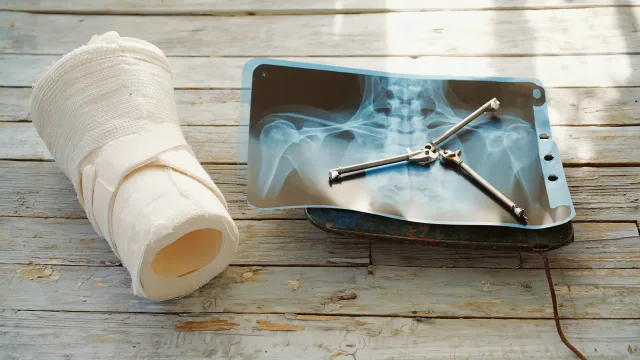
The first step is often the same regardless: if the bone has shifted, we "reduce" it, meaning we set it back into a good position, usually with local anaesthetic, and hold it in a plaster cast. If the bone sits well and stays put, a cast alone will heal it beautifully. We confirm this with X-rays in the first couple of weeks, because some fractures try to slip back out of position.
Surgery, usually a plate and screws on the front of the bone, comes into the picture when the fracture is badly displaced, unstable, or breaks into the wrist joint surface where precise alignment matters. The aim of surgery is a better-positioned, more stable wrist, not simply a faster one.
Surgery vs cast in patients over 60
From a network meta-analysis of 23 randomised trials (2020 patients) · via PubMed
Small, often not meaningful
differences in wrist score and grip strength between plate fixation and a cast (PRWE about 4.5 points; grip about 6%)
A cast is often a sound choiceA trade-off
plate fixation had the lowest rate of minor complications, but one of the higher rates of major complications
No free lunch with surgeryGutiérrez-Espinoza et al, 2023, network meta-analysis of randomised trials in patients older than 60.
This is why I do not push every older patient toward surgery. For many, a cast gives a result just as good for daily life, without an operation. For a younger, high-demand patient or a fracture into the joint, the balance often shifts toward fixing it. It is a genuine decision, made with you.
The healing timeline, week by week
Here is the honest map of recovery, whether you are treated in a cast or with surgery.
Weeks 0 to 6: holding still
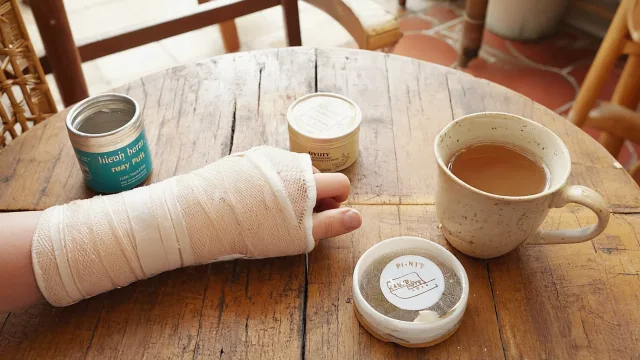
The wrist is protected in a cast (or healing around its plate) for roughly six weeks while the bone unites. During this time the wrist stays put, but the rest of the arm must not. Keep your fingers, elbow and shoulder moving freely every day. The single most common avoidable problem after a wrist fracture is a stiff hand and shoulder from disuse, not from the fracture itself.
Weeks 6 to 12: waking the wrist up
Once the bone has healed and the cast is off, the wrist will feel stiff, weak and strange. This is expected. You begin gentle movement exercises, bending the wrist up and down and rotating the forearm, and progress gradually. Grip will be noticeably weaker than the other side at first. Do not be discouraged; this is the starting point, not the final result.
Months 3 to 6: getting strength back
Movement returns first, strength follows. Over these months grip and endurance build with continued exercises, and most people return to their normal activities. The last few degrees of movement and the final grip strength can take the longest, and a hand therapist can help if progress stalls.
A note on therapy
Patients often ask whether they need formal physiotherapy or can just do exercises at home. According to a Cochrane review on PubMed, the evidence is not strong enough to say one specific rehabilitation programme is clearly best, and for many people a good home exercise programme with clear instruction works well. Where the hand stays stiff or weak, supervised hand therapy is worth it. The non-negotiable part is that you do the movement, in some form.
Setting honest expectations
Most people recover excellent use of the wrist. But "recovered" does not always mean identical to before. A minority, particularly after a more severe fracture, notice some lasting stiffness, occasional aching, or a wrist that complains in cold weather or with heavy loads. This is worth knowing in advance, not so you worry, but so you are not alarmed if your wrist takes months rather than weeks to feel like your own again. That timeline is normal.
Helping yourself recover well
A few things genuinely help. Keep the fingers, elbow and shoulder moving from the very first day. Elevate the hand early to control swelling. Keep your follow-up appointments and X-rays so we catch any slippage in time. Do your exercises consistently once the cast is off, because consistency beats intensity. And if you have osteoporosis, treat it, because a wrist fracture from a simple fall is often the first warning that the bones need attention before a more serious fracture follows.