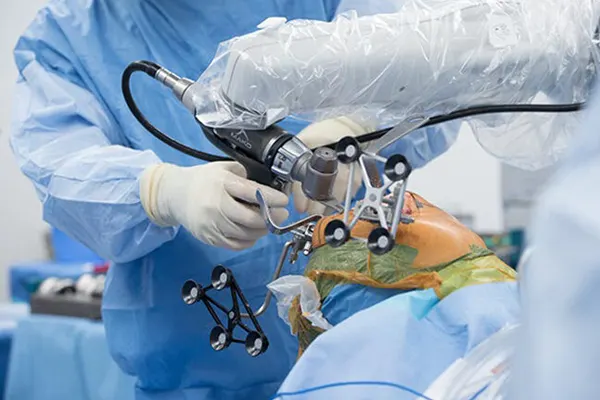
Robotic Knee Replacement
at Aster MIMS Kannur
Your knee is unique. Your surgery should be too. The CORI Surgical System maps your anatomy in real time and positions your implant with sub-millimetre precision, giving you a knee replacement tailored to your body, not a one-size-fits-all template.
Medically reviewed by Dr. Vishnu Baburaj, MS Ortho (PGI Chandigarh), MRCS (UK) · Last updated July 2026
What is the CORI Surgical System?
The CORI Surgical System, developed by Smith+Nephew, is a robotic platform designed specifically for total knee replacement surgery. Unlike older robotic systems that require a pre-operative CT scan, CORI creates a real-time three-dimensional map of your knee anatomy during the procedure itself. This means the surgical plan is based on your actual bone surfaces, not on images taken days or weeks earlier.
Every knee is different. The CORI system lets me see those differences in three dimensions and respond to them with a level of precision that conventional instruments simply cannot achieve.
Dr. Vishnu BaburajReal-time 3D bone mapping
CORI scans the bone surface during surgery and builds a live three-dimensional model. No pre-operative CT scan required. No additional radiation. The map updates continuously as the surgeon works, ensuring every measurement reflects your actual anatomy.
Surgeon-controlled precision
The robot assists; the surgeon decides. Every cut, every angle, every implant position is controlled by Dr. Vishnu. CORI provides guidance and feedback, but it is a precision instrument in the surgeon's hands, not an autonomous system performing the procedure.
Established implant systems
Smith+Nephew knee implants with published survivorship data exceeding 95% at 15 to 20 years. Cemented fixation for reliable long-term stability. Every patient receives a full implant identification card at discharge.
Robotic vs Conventional Knee Replacement
Both robotic-assisted and conventional knee replacement are proven procedures with excellent long-term outcomes. The key differences lie in the consistency of implant positioning and the precision of soft tissue balancing. Published studies show that robotic-assisted TKR reduces the rate of alignment outliers and may contribute to faster early recovery.
Robotic-Assisted TKR
CORI SystemAlignment guided by real-time 3D bone mapping with sub-millimetre accuracy
Soft tissue balance measured objectively with intraoperative sensors
Significantly fewer alignment outliers in published comparative studies
Bone preparation tailored to patient-specific anatomy in real time
Evidence note: A 2023 meta-analysis in the Journal of Arthroplasty found that robotic-assisted TKR achieved significantly better mechanical axis alignment compared to conventional techniques, with a reduced rate of outliers beyond 3 degrees. Studies also report comparable or improved early functional outcomes and patient satisfaction scores at short-term follow-up.
Who is a candidate for robotic knee replacement?
Robotic-assisted knee replacement is suitable for patients with end-stage knee arthritis who have not responded to conservative treatment. The following conditions are commonly treated with this procedure at Aster MIMS Kannur.
Primary Osteoarthritis
The most common indication. Wear-and-tear arthritis causing bone-on-bone contact, persistent pain, and progressive loss of mobility despite medications and physiotherapy.
Rheumatoid Arthritis
Inflammatory arthritis that destroys the joint lining and cartilage. When medical management fails to control joint destruction, replacement restores function and eliminates inflammatory pain.
Post-Traumatic Arthritis
Arthritis developing years after a significant knee injury such as a tibial plateau fracture or ligament injury. The damaged joint surface progressively deteriorates, leading to end-stage disease.
Valgus or Varus Deformity
Knock-knee or bow-leg deformity caused by asymmetric cartilage loss. Robotic assistance is especially valuable here, as precise ligament balancing is critical for correcting the alignment.
Stiff Knee
Severe loss of range of motion from advanced arthritis or previous surgery. Robotic planning allows the surgeon to optimise implant positioning for maximal flexion recovery.
Avascular Necrosis
Loss of blood supply to the bone around the knee, leading to collapse of the joint surface. When the damage is extensive, total knee replacement is the definitive solution.
Not sure if you qualify?
Send us your X-rays or MRI and we will assess your suitability.
Ask on WhatsAppFrom consultation to recovery
Assessment and planning
Your journey begins with a thorough clinical examination and weight-bearing X-rays. Dr. Vishnu assesses the extent of cartilage damage, deformity, ligament integrity, and your functional goals. If surgery is appropriate, a detailed plan is developed. Pre-operative blood work and cardiac clearance are completed, and your questions are addressed before any decision is made.
Surgery day with CORI
Under spinal anaesthesia with sedation, the CORI system maps your knee anatomy in real time. Dr. Vishnu uses this live 3D model to position bone cuts and the implant with sub-millimetre accuracy. The entire procedure takes approximately 60 to 90 minutes. Ligament balance is checked and fine-tuned before final implant fixation. You are in the recovery room within two hours.
Early mobilisation
Within hours of surgery, a physiotherapist assists you to sit up and begin gentle knee exercises. Most patients walk with a frame or walker within 24 hours. Our multimodal pain management protocol combines nerve blocks, anti-inflammatory medication, and targeted analgesics to keep you comfortable without heavy sedation. Early movement is central to a strong recovery.
Discharge and rehabilitation
Discharge typically occurs on Day 3 to Day 5 with a structured home exercise programme. Follow-up appointments are scheduled at Week 2 (wound check), Week 6 (X-ray and assessment), and Month 3 (functional evaluation). A physiotherapy protocol tailored to your progress guides the transition from walking aids to independent mobility. Most patients return to driving at 4 to 6 weeks.
Assessment and planning
Your journey begins with a thorough clinical examination and weight-bearing X-rays. Dr. Vishnu assesses the extent of cartilage damage, deformity, ligament integrity, and your functional goals. If surgery is appropriate, a detailed plan is developed. Pre-operative blood work and cardiac clearance are completed, and your questions are addressed before any decision is made.
Surgery day with CORI
Under spinal anaesthesia with sedation, the CORI system maps your knee anatomy in real time. Dr. Vishnu uses this live 3D model to position bone cuts and the implant with sub-millimetre accuracy. The entire procedure takes approximately 60 to 90 minutes. Ligament balance is checked and fine-tuned before final implant fixation. You are in the recovery room within two hours.
Early mobilisation
Within hours of surgery, a physiotherapist assists you to sit up and begin gentle knee exercises. Most patients walk with a frame or walker within 24 hours. Our multimodal pain management protocol combines nerve blocks, anti-inflammatory medication, and targeted analgesics to keep you comfortable without heavy sedation. Early movement is central to a strong recovery.
Discharge and rehabilitation
Discharge typically occurs on Day 3 to Day 5 with a structured home exercise programme. Follow-up appointments are scheduled at Week 2 (wound check), Week 6 (X-ray and assessment), and Month 3 (functional evaluation). A physiotherapy protocol tailored to your progress guides the transition from walking aids to independent mobility. Most patients return to driving at 4 to 6 weeks.
Why Aster MIMS Kannur?
Aster MIMS Kannur is an NABH-accredited multispecialty hospital and part of the Aster DM Healthcare network, one of the largest integrated healthcare providers in the Middle East and India. The orthopaedic department operates a dedicated joint replacement suite equipped with the CORI robotic system, laminar airflow theatres, and a rapid recovery programme designed to get you home sooner.
Book OP ConsultationNABH Accredited
National Accreditation Board for Hospitals certification, verifying adherence to patient safety and quality standards across every department.
Dedicated Joint Replacement Suite
Laminar airflow operating theatre with the CORI robotic system permanently installed. Purpose-built for high-volume arthroplasty with ultra-low infection rates.
Rapid Recovery Protocol
Multimodal analgesia, early mobilisation from Day 0, and structured physiotherapy. Designed to minimise hospital stay and accelerate your return to independence.
Continuous Post-Operative Support
WhatsApp access to the surgical team throughout recovery. Scheduled video follow-ups for patients who cannot visit in person. Your care does not end at discharge.
What does robotic knee replacement cost?
Quoted individually
The total depends on the implant or fixation used, room category, any associated procedures, and length of stay. You receive a written estimate before any decision is made.
Insurance & cashless
Most major insurers cover surgery at Aster MIMS Kannur. Cashless admission and pre-authorisation assistance are available; the insurance desk confirms your policy coverage before admission.
Get a written estimate
Send your reports on WhatsApp and receive a personalised estimate, with no obligation.
Request EstimateWhat does recovery actually look like?
Walk through the knee replacement timeline phase by phase, robotic included: how it feels, what to work on, and when to call us.
Travelling from outside India?
The CORI Surgical System is available at Aster MIMS Kannur. Suitability, implant choice, medical fitness, travel and rehabilitation are considered together for each patient. Start with a provisional review of your existing records before making travel arrangements.
Robotic knee replacement FAQ
Is the robot performing my surgery?
No. The CORI system is a precision tool controlled entirely by Dr. Vishnu. He makes every decision during the procedure. The robot provides real-time 3D bone mapping and guided positioning, but the surgeon controls every cut and every placement. Think of it as GPS for knee surgery: the system provides the map, while the surgeon drives.
How much does robotic knee replacement cost?
The cost varies based on implant choice, whether one or both knees are being replaced, and your specific clinical needs. Robotic knee replacement at Aster MIMS Kannur is priced competitively and is significantly more affordable than comparable procedures in the UK, US, or Middle East. Contact us via WhatsApp or the appointment form for a personalised cost estimate.
Do I need a CT scan before surgery?
No. Unlike some robotic systems that require a pre-operative CT scan, the CORI system creates a real-time 3D map of your knee anatomy during surgery itself. This eliminates the radiation exposure, additional cost, and scheduling delays associated with pre-operative CT scanning. Standard weight-bearing X-rays are sufficient for pre-operative planning.
What is the recovery time?
Most patients walk with support within 24 hours of surgery. Discharge from hospital typically occurs on Day 3 to Day 5. Return to driving takes approximately 4 to 6 weeks. Full recovery, including return to recreational activities, usually takes 3 to 6 months. The precision of robotic-assisted surgery often results in less soft tissue disruption, which can support a faster and more comfortable recovery compared to conventional techniques.
Is there an age limit?
There is no strict age limit. Suitability is determined by the severity of your arthritis, overall health, and functional goals rather than age alone. Dr. Vishnu has performed knee replacements on patients ranging from their early 50s to their late 80s. A thorough pre-operative assessment including cardiac and anaesthetic evaluation ensures that surgery is safe for you.
Can both knees be done at the same time?
Yes, bilateral (both knees) robotic knee replacement can be performed in a single sitting for suitable patients. This is assessed on a case-by-case basis depending on your overall fitness, cardiac health, and the severity of arthritis in each knee. Simultaneous bilateral replacement means one anaesthetic, one hospital stay, and one rehabilitation period instead of two.
Which implant brands are used?
The CORI Surgical System is manufactured by Smith+Nephew, a globally recognised orthopaedic implant company. The implants used are from Smith+Nephew's established knee replacement range, with published survivorship data exceeding 95% at 15 to 20 years. All implants are CE-marked and internationally certified. A full implant card with serial numbers is provided at discharge.
Robotic Knee Replacement, Your Questions Answered
What "robotic" really means, who qualifies, and what recovery looks like, in Dr. Vishnu's own words.
Your First Week After Total Knee Replacement
Day-by-day recovery guide covering pain management, early walking, home setup, and when to call your surgeon.
Knee Replacement for Diabetic Patients
HbA1c thresholds, medication adjustments, infection risk, and what makes diabetic knee replacement different.