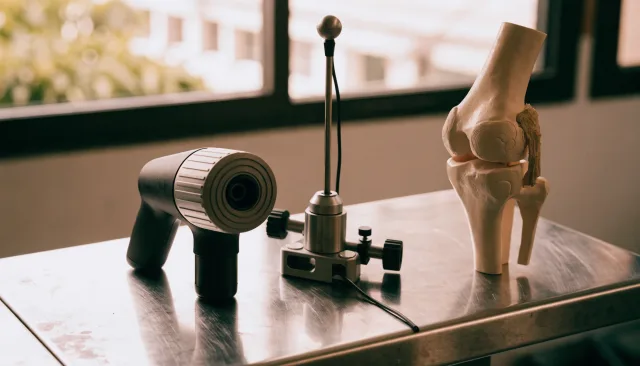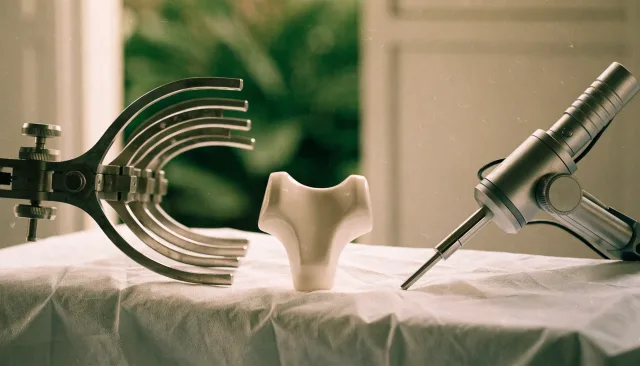
Almost every week, a patient sits across from me in Kannur and asks the same question: "Doctor, should I have the robotic knee or the normal one?" It is a fair question, and it deserves a straight answer rather than a sales pitch. So let me tell you exactly what differs between robotic and traditional knee replacement, and just as importantly, what does not.
I am Dr. Vishnu Baburaj, an orthopaedic surgeon at Aster MIMS Hospital, Kannur (MS Orthopaedics, PGIMER Chandigarh; MRCS, UK). I perform both manual and robotic-assisted knee replacement, using the Smith and Nephew CORI system. That means I have no reason to oversell either one. My job here is to lay out the evidence plainly so you can decide what matters to you.
What both operations have in common
Start with the obvious. In both robotic and traditional total knee replacement, the same surgeon does the same fundamental operation. The worn joint surfaces are removed and replaced with a metal and plastic implant. The incision, the implant, the anaesthetic, and the rehabilitation that follows are essentially the same. A robot does not operate on you. I do.
The single real difference is how the implant position is planned and how accurately that plan is delivered. Everything that flows from that is a question of precision, not a different surgery.
What genuinely differs
Here is the honest scorecard, drawn from pooled data across randomised trials. Robotic assistance changes a handful of measurable things. It does not change as many as the marketing might suggest.
- Alignment accuracy: fewer outliers, closer to the planned neutral position
- Blood loss: may be lower on average
- Operative time: longer, about 20 minutes more
- Recovery: broadly similar so far
- Cost: generally higher
- Alignment accuracy: excellent in skilled hands, more variability across cases
- Blood loss: well controlled with modern technique
- Operative time: shorter on average
- Recovery: broadly similar so far
- Cost: generally lower
The precision finding, in plain numbers
The most consistent advantage of robotic surgery in the literature is fewer "alignment outliers". An outlier is a knee whose final alignment lands further from the planned target than we would like. The robotic system reduces how often that happens. Two separate meta-analyses of randomised trials put hard numbers on this.
Fewer alignment outliers
Relative risk of a knee landing outside the target alignment zone (lower is better)
RR 0.43
Robotic surgery cut the risk of an alignment outlier to roughly two-fifths of conventional surgery, across 12 trials and 2,200 patients.
Ruangsomboon 2023RR 0.33
A larger pooled analysis of 21 trials and 2,692 patients found the outlier risk cut to about one-third of conventional surgery.
Mostafa 2025The deviation from neutral alignment is also smaller. In both analyses, robotic knees sat on average around 0.9 degrees closer to the intended neutral axis than manually instrumented knees.
Deviation from neutral alignment
Mean difference vs conventional surgery · closer to zero is the goal
Bars are scaled for illustration; both findings represent a sub-degree improvement in average alignment accuracy.
Why alignment precision might matter (and why we cannot promise it does)
Here is the part that needs care. It is reasonable to think that a more accurately aligned implant should last longer and feel more natural, because poor alignment is one known driver of implant wear and early loosening. That logic is sound. But the trials so far have not shown that the extra precision translates into better pain, function, or fewer revisions in the short to medium term. The two meta-analyses above found no meaningful difference in WOMAC scores, Oxford Knee Scores, or revision rates between the two approaches.
What stays the same
In the published randomised trials, robotic and traditional knee replacement produce similar short to medium term results for the things patients care about most:
- Pain relief and how the knee feels day to day
- Function scores (WOMAC, Oxford Knee Score) and range of motion
- Patient satisfaction
- Complication rates and early revision rates
The proven edge of robotics is precision. Whether that precision pays off over fifteen or twenty years is biologically plausible but not yet proven in the data.
So I do not tell my patients that a robotic knee will feel better than a manual one. I tell them it will be positioned more consistently, that consistency is a worthwhile goal, and that we are still waiting on the long-term outcome data to confirm the payoff.
The CORI system I use at Aster MIMS Kannur
When I do offer robotic assistance, I use the Smith and Nephew CORI system. It is worth understanding what kind of robotic system it is, because not all of them work the same way.
CORI is a handheld, image-free system. That phrase matters in two ways:
- Image-free means it does not need a pre-operative CT scan or MRI to build its plan. During the operation I map your own bone landmarks with a handheld probe, the software builds a 3D model of your specific knee, and it checks the soft-tissue gaps through the range of motion. For you, that means no extra scan to schedule beforehand and no additional radiation from a planning CT.
- Handheld means I control a precision handpiece directly, guided by the system, rather than working through a separate robotic arm. The system keeps the bone preparation within the plan while I remain hands-on throughout.
The other common approach is a robotic-arm system such as Mako, which is CT-based: it uses a planning scan beforehand and a semi-active arm that provides tactile boundaries during cutting. Both approaches chase the same goal of precise, patient-specific implant positioning. There is no robust evidence that one robotic system produces better patient outcomes than another, so the choice usually reflects the implant system and what the hospital and surgeon use. If you want the longer version, I have written a fuller guide to robotic knee replacement.
So which should you choose?
For most patients, an excellent result is achievable either way. A carefully aligned manual knee replacement in experienced hands remains one of the most reliable operations in all of surgery. Robotic assistance adds a layer of measurable consistency, and for some patients, particularly those with unusual anatomy or significant deformity, that consistency is especially appealing.
The decision is not really "robot versus surgeon". It is "which tools should this surgeon use for this knee". That is a conversation I would rather have with you in person, looking at your X-rays and your goals. You can read more about the procedure itself on my robotic knee replacement page and the general knee replacement overview, or request an appointment to discuss your own knee.
"I do not sell the robot. I use it when it helps, and I tell you honestly when it does not change much. That is the deal."