If your surgeon has mentioned a "robotic" knee replacement, it is natural to picture a machine working on its own while everyone watches a screen. That is not what happens. The CORI system I use at Aster MIMS Kannur is better thought of as a very precise navigation tool that stays in the surgeon's hands the whole time. This guide explains, in plain language, exactly what it is and how a CORI procedure works step by step.
What CORI actually is
CORI is a robotics-assisted surgical system made by Smith+Nephew. Two features make it stand out, and both matter to you as a patient.
First, it is handheld. Rather than a large robotic arm, the working part is a compact tool the surgeon holds and controls directly. Second, it is image-free. Some robotic systems need a CT scan before surgery to build their plan. CORI does not. Instead, the surgeon collects the information the system needs during the operation itself, by mapping your real anatomy.
That combination is the heart of how CORI works, and it is why the experience leading up to your surgery is no different from a standard knee replacement: there is no extra scan to book, and no planning CT to sit through.
The image-free part: what it means for you
Image-free, in plain terms
- No pre-operative CT scan or MRI is needed just to plan the robotic part of your surgery.
- No extra radiation from a planning CT, because the 3D model is built from your bone during the operation.
- Nothing extra to schedule before surgery, which keeps your journey simpler.
- The plan is built on your real anatomy on the day, not on a scan taken weeks earlier.
You will still have the usual X-rays and assessments that any knee replacement requires. What you avoid is the additional CT scan that some other robotic systems rely on.
How a CORI procedure works, step by step
Here is the sequence I follow in theatre. It is the same logical order I would use for any knee replacement, with the system adding precision at each stage.
Map the bone landmarks
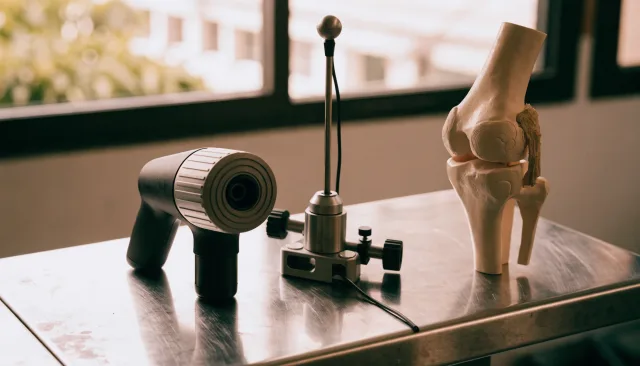
Once the knee is opened, I touch a handheld probe to key points on your femur and tibia. The system records the exact position of your own bone, with no scan required.
Build the 3D plan and check alignment
The software turns those points into a 3D model of your knee. I then move the knee through its range of motion so the system can assess the gaps and ligament balance, and I plan exactly where the implant should sit.
Guided bone preparation
I remove the worn bone using a surgeon-controlled handpiece. The system guides the tool to the planned positions, helping me prepare the surfaces precisely. My hand does the work; the guidance keeps it accurate.
Balance and place the implant
I position the implant according to the plan, then re-check the balance through the full range of motion. The aim is a knee that is well aligned and evenly balanced, which is the foundation of a smooth, stable result.
At no point does the robot operate on its own. CORI guides and measures. The surgeon plans, cuts, balances and decides. The control never leaves my hands.
At a glance: the CORI system
Form
Handheld
A compact, surgeon-controlled tool, not a large robotic arm.
Imaging
Image-free
No pre-operative CT scan or MRI to plan the robotic step.
How it plans
Intra-operative mapping
Builds a 3D model from your own bone during surgery.
Who controls it
The surgeon
Every cut and decision stays with the operating surgeon.
What the evidence really shows
The honest, well-proven benefit of robotic assistance is precision. When researchers pool the results of randomised trials comparing robotic-assisted and conventional knee replacement, the robotic group consistently has fewer alignment outliers, meaning fewer knees that end up further from the planned position. In one systematic review of randomised trials, robotic assistance reduced the risk of mechanical-alignment outliers substantially compared with conventional instruments.
It is just as important to be clear about what the evidence does not yet show. In the first few years after surgery, pain scores, function and patient satisfaction tend to be broadly similar between robotic and manual surgery, and complication and revision rates are comparable. Robotic surgery also tends to take a little longer in theatre. So the fair summary is this: the proven edge is accuracy and consistency, not a guaranteed better-feeling knee.
The honest part
I will never tell you that a robot guarantees a better outcome. What it gives me is a more reliable way to hit a precise plan. Precision is a sound foundation, but your result also depends on the right operation for your knee, careful surgery and your own rehabilitation effort.
How CORI compares with other robots
You may have read about the Mako system, which is also used for knee replacement. The main difference is design, not a contest. CORI is handheld and image-free, mapping your bone during surgery. Mako is a robotic arm that uses a pre-operative CT scan to build its plan. Both share the same goal of precise, patient-specific implant positioning, and there is no robust evidence that one robotic system produces better patient outcomes than another. The choice usually reflects the implant system and what the hospital and surgeon use.
Having CORI robotic knee replacement in Kannur
I am Dr. Vishnu Baburaj, consultant orthopaedic surgeon at Aster MIMS Hospital, Kannur, with an M.S. in Orthopaedics from PGIMER Chandigarh and MRCS from the UK. I use the Smith+Nephew CORI system for suitable patients across North Kerala and Malabar, including those travelling from Thalassery, Payyannur, Taliparamba, Mattannur and Iritty.
If you want to understand whether robotic assistance is right for your knee, the best starting point is a proper assessment. You can read more on our robotic knee replacement page, see how it fits within knee replacement surgery overall, or go deeper with our detailed guide to robotic knee replacement. When you are ready, you can request an appointment or a second opinion through the clinic.