If you have already worked through whether your tear actually needs an operation, and decided with your surgeon that it does, this article is the next step. It is the surgical companion to my piece on whether a rotator cuff tear always needs surgery, so I will not re-argue that decision here. Instead I want to answer the two questions every patient asks me once the decision is made: what does the operation actually do, and what does recovery really look like.
I perform this surgery arthroscopically, through keyhole incisions, at Aster MIMS Hospital in Kannur. The honest headline is this: the operation itself is well understood and usually goes smoothly, but the recovery is longer and more demanding than most people expect. A repaired tendon has to heal back onto bone, and bone biology does not hurry. So let me walk you through both halves, the surgery and the months that follow.
What an arthroscopic cuff repair actually does
The rotator cuff is a set of four flat tendons that wrap over the top of the shoulder and hold the ball of the joint snugly in its socket while you lift, reach and rotate. A full-thickness tear means one of those tendons has pulled away from the small patch of bone, called the footprint, where it normally attaches. The aim of a repair is simple to state: put the tendon back on its footprint and hold it there securely enough that it can heal to bone.
In keyhole surgery, this is done without any large muscle-splitting cut. A few small incisions are made around the shoulder. Through one, a pencil-thin camera (the arthroscope) is passed in, sending a magnified view of the inside of the joint to a screen. Through the others, fine instruments work on the tendon. The torn, frayed edge is gently freed and brought back to where it belongs, and the bony footprint is cleaned and lightly prepared so the tendon has a healthy surface to knit onto.
The repair is essentially re-anchoring tendon to bone: tiny anchors are screwed or tapped into the bone, and the strong sutures they carry are passed through the tendon and tied to hold it down on its footprint while it heals.
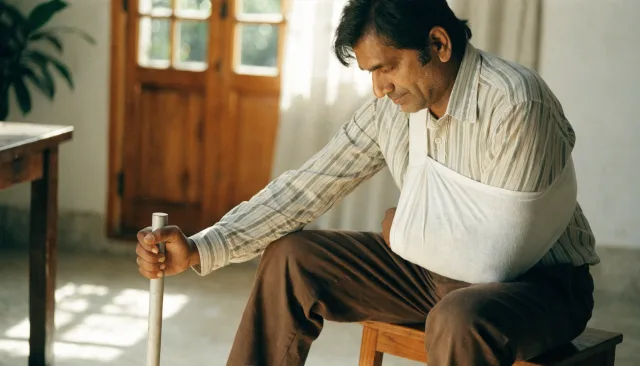
Those anchors are small implants, often made of biocompatible material, each preloaded with high-strength suture. Depending on the size and shape of the tear, a surgeon may use a single row of anchors or two rows to spread the tendon more broadly across its footprint. The sutures are passed through the body of the tendon and tied down, pulling the tendon onto bone under controlled tension. Once that is secure, the instruments come out and the small incisions are closed. Because there is no large open wound and the deltoid muscle is left largely undisturbed, most patients go home the same day or the next, with the arm resting in a sling.
Keyhole or mini-open: does it change the result?
Patients often ask whether the keyhole approach gives a better outcome than a mini-open repair, where a small open incision is added. It is a fair question, and the honest answer is reassuring: for the final result, the approach matters far less than people assume.
Arthroscopic vs mini-open repair
What two meta-analyses found when they pooled the comparative studies
No difference
In function, pain, re-tear rate or range of motion between all-arthroscopic and mini-open repair, across 21 studies and 1,644 procedures.
Migliorini 2021No difference
In function, pain, re-tear or adhesive capsulitis between the two techniques, across 12 studies and 770 patients with small to large tears.
Shan 2014When researchers have pooled the comparative studies, all-arthroscopic repair and mini-open repair have come out broadly equal on the outcomes that matter to patients: pain, function, range of movement and the chance the repair holds. One meta-analysis of 21 studies covering 1,644 procedures found no difference between the two in function, pain, re-tear rate or range of motion. A separate meta-analysis of 12 studies and 770 patients reached the same conclusion across small to large tears, with no difference in re-tear or stiffness either.
So the choice of approach is really about how the surgery is delivered, not how it ends. Arthroscopic repair achieves the same repair through smaller incisions with less disruption to the deltoid, which is why I prefer it, but the quality of the repair and the rehabilitation that follows are what truly decide the result. You can read more about the keyhole technique itself on my shoulder arthroscopy page.
The recovery, stage by stage
This is the part I spend the most time on in clinic, because the surgery is the short chapter and recovery is the long one. A repaired tendon is not strong on day one. It is held in place by sutures while your own biology slowly reattaches it to bone, and that healing unfolds over months. Recovery is therefore staged deliberately, and each stage exists to protect the one before it. Here is the shape of it.
The recovery, in four phases
-
1
Protection
The arm rests in a sling for several weeks so the repaired tendon is not loaded while it begins to heal to bone. Early gentle finger, wrist and elbow movement keeps those joints supple, but the shoulder itself is protected.
-
2
Passive motion
A physiotherapist (or your other hand) moves the shoulder for you, so range of movement is restored without the cuff muscles having to pull on the fresh repair. The tendon is healing, not yet working.
-
3
Active motion
Once the repair has had time to take, you begin moving the arm under its own power, first against gravity alone. This is the bridge between a protected shoulder and a working one.
-
4
Strengthening and return
Only in the later phase do we add progressive strengthening to rebuild the cuff and surrounding muscles. Genuine, dependable strength returns gradually, and full strength typically takes many months.
I deliberately keep the week numbers general, because the right pace depends on your tear and how it is healing, not on a fixed calendar. A small repair in a healthy shoulder may move through these phases sooner than a large repair under tension. The principle, though, is constant: passive before active, active before strengthening, and nothing rushed. Push a tendon too hard before it has knitted to bone and you risk undoing the very thing the surgery achieved.
It is worth saying plainly that this is a longer road than a simple clean-up arthroscopy, where there is no tendon to protect and people often recover quickly. A repair is different precisely because something has to heal. Most patients are using the arm comfortably for light daily tasks well before the shoulder is fully strong, and the final stretch back to full power is measured in months.
What affects healing, and the honest question of re-tear
A repair is a race between healing and failure. The sutures hold the tendon in place, but it is your own biology that has to reattach it to bone, and sometimes the repair does not fully heal, which is called a re-tear. I would rather you hear the real factors from me than discover them later, so here they are, divided into what you cannot change and what you can.
Factors linked to higher re-tear risk
Drawn from the comparative repair studies and from healing biology
Older age
Older age was associated with higher re-tear rates after repair in the pooled comparative data. Tendon quality declines with age, which works against healing.
Not modifiableMale sex
Male sex was also linked to higher re-tear rates in the same meta-analysis, alongside older age.
Not modifiableLarger tears
Bigger tears place the repair under more tension and have more ground to heal, so they carry a higher chance of re-tear than small ones.
Partly modifiableSmoking · diabetes · rushed rehab
Smoking and poorly controlled diabetes hinder tendon healing, and skipping or rushing the staged rehabilitation can overload the repair before it is ready.
In your handsThe studies that compared arthroscopic and mini-open repair both noted that older age, and in one of them male sex, were associated with higher re-tear rates regardless of which technique was used. Larger tears are harder to repair and heal less reliably than small ones, simply because there is more tendon to reattach and more tension on the repair. None of these is a reason to avoid surgery when it is the right choice. They are reasons to set realistic expectations and to do everything within your control to help the repair succeed.
What helps it heal
Some of the most powerful factors in a successful repair are entirely yours. Stopping smoking gives the tendon a far better blood supply to heal with. Keeping diabetes well controlled supports the same healing tissue. And, above all, following the staged physiotherapy faithfully, protecting the repair early and not racing back to heavy or overhead use, gives the tendon the undisturbed time it needs to knit onto bone.
I would rather a patient be a little impatient with me in clinic than impatient with their own tendon at home. The sling and the rehab are not obstacles to recovery. They are the recovery.
What I tell my patients
Arthroscopic rotator cuff repair is a good operation, and for the right tear it restores a shoulder that pain and weakness had taken away. But it asks something of you in return. The keyhole surgery puts the tendon back on bone and holds it there; your patience over the following months is what lets it actually heal. Go in expecting a staged recovery, not a switch that flips, and you will be ready for the real shape of it.
If you have a confirmed tear and want to talk through whether repair is right for you, and what your particular recovery would look like, you can arrange a consultation through my clinical contact page. I will give you the same honest picture there that I have given here.