If your shoulder has been hurting, catching or letting you down, and someone has mentioned the word "arthroscopy," it is natural to picture a big operation and a long trip to a city far from home. Neither is usually the case. Shoulder arthroscopy is keyhole surgery, and at Aster MIMS Hospital in Kannur it is something I do regularly for patients across North Kerala. This guide walks you through what it is, the problems it treats, and exactly what to expect from first consultation to recovery.
I am Dr. Vishnu Baburaj, a consultant orthopaedic surgeon with a master's in orthopaedics from PGIMER Chandigarh and the MRCS from the UK, and a shoulder is one of the joints I look after most. Let me start with what the operation actually is, because the name sounds more daunting than the reality.
What shoulder arthroscopy actually is
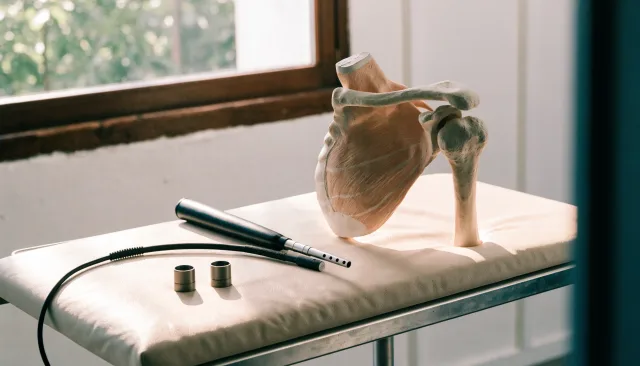
Arthroscopy means looking inside a joint with a camera. Through one small incision, usually only a few millimetres across, I pass a thin telescope called an arthroscope, which sends a magnified, brightly lit view of the inside of your shoulder to a screen. Through one or two further small incisions I pass fine instruments to repair, tidy or release whatever needs attention. Because the joint is not opened up in the old way, the muscles and other soft tissues around it are disturbed far less than in open surgery.
That is the heart of the "keyhole" idea: a clear view and precise work, through openings small enough that most are closed with a stitch or two. It lets me both diagnose and treat in the same sitting, seeing the cartilage, tendons and ligaments directly rather than relying on the scan alone.
Keyhole shoulder surgery is not a smaller version of a different operation. It is a precise, camera-guided way of doing the right operation through small incisions, available right here in Kannur.
The shoulder problems we treat by arthroscopy
A great many of the common shoulder conditions can be addressed through the keyhole approach. These are the ones I see and treat most often at Aster MIMS Kannur.
Rotator cuff tears
The cuff tendons that hold and move the shoulder can tear with age or after an injury. Many tears can be reattached arthroscopically. Not all of them need surgery, though, which is a decision we make together.
Instability and dislocations
A shoulder that keeps slipping out or feels like it might can often be stabilised with a keyhole repair of the torn rim and ligaments, a Bankart repair.
Impingement
Pain on reaching overhead, where soft tissue is pinched under the bony arch. Importantly, this often responds to exercise, so surgery is far from automatic here.
Labral tears
Tears of the cartilage rim, including Bankart and SLAP lesions, are managed by age and activity: repair for some, a tidy-up or a different procedure for others.
Frozen shoulder
Most frozen shoulders settle without an operation. For the stubborn few that do not, an arthroscopic release of the tight capsule is an option.
Diagnostic clarity
When the scan and the symptoms do not quite agree, the camera lets us see the joint directly and treat what is genuinely there.
You can read more on the shoulder arthroscopy procedure page for the technical detail of each repair.
The honest part
A keyhole operation is still an operation, and a smaller scar does not make an unnecessary surgery worthwhile. For shoulder impingement, a large placebo-controlled trial followed patients for five years and found that arthroscopic subacromial decompression gave no meaningful benefit over a structured exercise programme, and no benefit over a placebo "look only" arthroscopy, for pain or function. That is exactly why I match the operation to the problem, and why a good rehab plan is often the right first answer. For a fuller look at this thinking, see my piece on whether a rotator cuff tear always needs surgery.
The patient journey, step by step
Knowing the path ahead takes a lot of the worry out of it. Here is how the journey usually runs for my shoulder patients at Aster MIMS Kannur.
Your journey, from first visit to recovery
-
1
Consultation and examination
We talk through how the trouble started, examine the shoulder, and work out what is most likely going on. Bring any old reports with you.
-
2
Imaging
X-rays and, where needed, an MRI or ultrasound confirm the diagnosis. The imaging is done in the same hospital, so there is no running between centres.
-
3
Deciding the plan together
If physiotherapy and time are the better route, we start there. If arthroscopy genuinely fits the problem, I explain what it would involve and why.
-
4
Day of surgery
The operation is keyhole, under anaesthesia. Simpler procedures are often day care or a short stay; larger repairs may need a night in hospital.
-
5
Early recovery
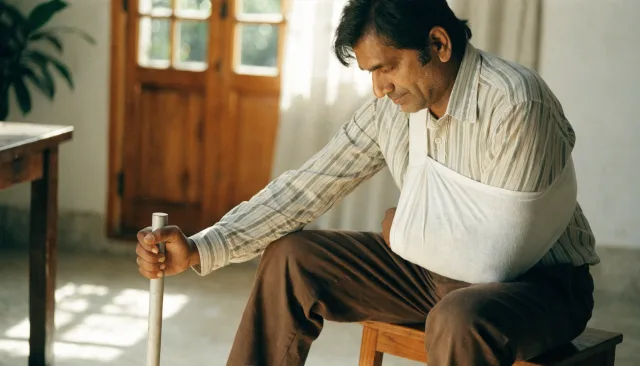
Your arm usually rests in a sling for a period that depends on what was done. Gentle finger, wrist and elbow movement starts early.
-
6
Physiotherapy and follow-up
A staged rehab programme rebuilds movement and strength over weeks to months. Being local makes these visits far easier to keep.
The length of each stage depends on the operation. A simple "clean-up" arthroscopy recovers more quickly than a repair, where the stitched tissue needs time to heal before it is loaded. I will give you a realistic picture for your specific procedure, rather than a one-size-fits-all timeline.
Why you do not need to leave North Kerala
Patients sometimes assume that good shoulder surgery only happens in the big cities. The instruments, the camera systems and the technique itself are the same wherever the work is done well. What truly matters is a surgeon who performs the operation regularly, a theatre set up for it, and a proper rehabilitation pathway. Those are all here in Kannur.
There is a practical point too. Recovery from shoulder surgery leans heavily on physiotherapy and on being seen again if something needs adjusting. If your surgeon and your rehab are hundreds of kilometres away, those follow-ups become a burden, and some get skipped. Having everything within reach of home tends to help recovery, not hinder it.
Serving North Kerala and Malabar
Aster MIMS Hospital is at Chala, Kannur, with a dedicated shoulder service. Patients reach us comfortably from across the region:
How to take the next step
If your shoulder is holding you back, the most useful thing is a proper assessment, not a guess. Come in with whatever scans or reports you already have, and we will work out together whether this is a problem for physiotherapy, an injection, or keyhole surgery. You can request an appointment through my clinical page, or, if you have already been told you need an operation and want to be sure, a second opinion is a sound and unhurried way to check.
Whatever the answer turns out to be, you should not have to leave Malabar to get a clear, honest plan for your shoulder.