The first time a shoulder dislocates, it is dramatic and painful. What worries me more, in clinic at Aster MIMS Kannur, is the second time, and the third. Once a shoulder has gone out more than once, it has usually crossed a line: this is no longer bad luck, it is an unstable joint, and an unstable shoulder rarely fixes itself.
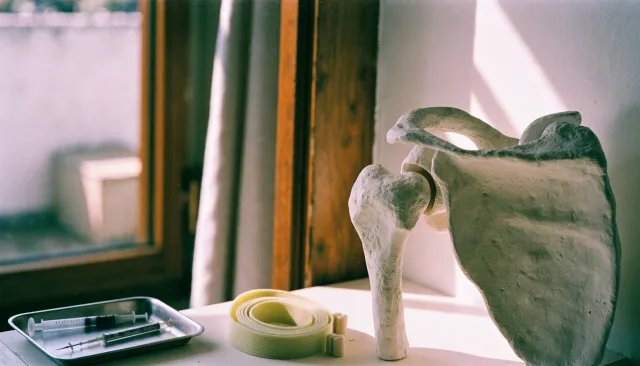
The shoulder is the most mobile joint in the body, which is exactly why it is the easiest to dislocate. The ball (the head of the upper arm bone) sits against a shallow socket (the glenoid). To stop the ball sliding off such a flat surface, the rim of the socket is deepened by a tough ring of cartilage called the labrum, with the joint capsule and ligaments attached to it. This soft-tissue bumper is what keeps the ball centred.
Why does a shoulder keep dislocating?
When the shoulder dislocates forwards (by far the commonest direction), the ball is forced off the front of the socket. As it does, it usually tears the labrum and capsule away from the front rim of the glenoid. That specific injury has a name: a Bankart lesion.
Once the labrum is detached, the front of the socket has lost its bumper. The ball now has a path of least resistance to slip out again, often with less and less force each time. This is why a shoulder that has dislocated once during a hard tackle can, months later, pop out simply reaching for a seatbelt or turning over in bed. The structure that should stop it is no longer anchored where it belongs.
A recurrent dislocation is rarely a weakness problem. It is usually an anatomy problem: the labrum has been torn off the rim, and physiotherapy alone cannot re-attach it.
Sometimes there is more than a soft-tissue tear. Each dislocation can chip or wear away bone, both from the front of the socket (glenoid bone loss) and from the back of the ball, where it impacts against the rim (a Hill-Sachs lesion). When these two bony injuries line up so the dent on the ball engages the edge of the socket, surgeons call it an "off-track" lesion. Bone loss matters, because it changes which operation will actually hold.
Who is at high risk of dislocating again?
Not every shoulder that dislocates once will keep doing it. The single biggest factor is age at the time of the first dislocation. A younger shoulder, with high activity demands, is far more likely to become recurrently unstable. The risk is compounded by sport, especially contact and overhead sport, and by the amount of bone and labral damage already done.
You are at higher risk of recurrence if...
- You are young, especially in your teens or early twenties.
- You play a contact or competitive sport (football, kabaddi, wrestling, rugby) or do heavy overhead work.
- Your shoulder has already dislocated more than once.
- Scans show glenoid bone loss or an off-track Hill-Sachs lesion.
- The shoulder feels loose or "about to go" with everyday movements, not just extreme positions.
If several of these apply to you, the question shifts from "will it dislocate again?" to "when?" and "how much more damage will accumulate before we act?" That is the conversation worth having early, while the bone is still largely intact.
What the evidence says about recurrence
A large systematic review published in 2024 pooled 111 studies and 19,307 patients to look specifically at what drives recurrent instability after arthroscopic Bankart repair. The pattern was clear and matches what we see in clinic.
Recurrence after arthroscopic Bankart repair
By age group · Bulleit et al, JSES 2024 (111 studies, 19,307 patients)
≈27%
Recurrent instability in patients under 20 years old after arthroscopic Bankart repair.
Under 20≈13.3%
Recurrent instability in older patients, roughly half the rate seen in the youngest group.
Older patientsWhat raises the risk of failure
Risk factors identified in the same review
Younger age
The strongest factor. A younger, more active shoulder is more likely to re-dislocate after repair.
Patient factorGlenoid bone loss
Missing bone from the socket rim leaves a soft-tissue repair with less to hold onto.
Bony factorOff-track Hill-Sachs
When the dent on the ball engages the socket edge, the repair is under more strain.
Bony factorContact sport
Competitive and contact athletes put the repaired shoulder under the heaviest, most repeated load.
Activity factorThe honest reading of this is twofold. First, repair clearly helps: leaving an unstable shoulder alone in a young athlete carries a much higher chance of further dislocations than fixing it. Second, repair is not a guarantee, and the same features that make a young athlete prone to dislocating in the first place also make their repaired shoulder work harder to stay in. Knowing your personal risk profile is what lets us plan the right operation, set honest expectations, and protect the result with a sensible return-to-sport plan.
How arthroscopic Bankart repair works
The goal of a Bankart repair is simple to state: put the labrum and capsule back where they came off, and hold them there while they heal. We do this arthroscopically, through small keyhole incisions, using a camera and fine instruments rather than opening the joint.
Through these portals, the torn labrum is identified and the bony rim is prepared so the tissue can re-attach. Small anchors are placed into the socket bone, each loaded with strong sutures. Those sutures are passed through the labrum and capsule and tied down, pulling the bumper back onto the rim and re-tensioning the front of the joint. As it heals, the labrum reunites with the bone and the soft-tissue restraint is restored. This is a soft-tissue repair, so it has to be protected while it heals, which is why recovery is staged over months rather than weeks. You can read more about the keyhole technique on the shoulder arthroscopy page.
The honest part
A Bankart repair re-attaches the labrum, but it cannot replace bone that has already worn away. That is the crucial distinction. If the socket has lost enough bone, a perfectly executed soft-tissue repair is being asked to do a job the anatomy no longer allows, and it is more likely to fail.
When bone loss means a different operation (Latarjet)
This is where the scans matter most. Before any stabilisation, we look carefully at how much bone has been lost from the front of the socket and whether the Hill-Sachs lesion on the ball is off-track. If the bone is largely intact, an arthroscopic Bankart repair is usually the right choice and does its job well.
If there is significant bone loss, the calculation changes. A soft-tissue repair alone has too little to anchor to and is more likely to come undone. In that situation, a different operation is often the better answer: the Latarjet procedure. Rather than only repairing soft tissue, it transfers a small block of bone, with its attached muscle, to rebuild the deficient socket rim and add a sling effect that holds the ball in place. It is a more involved operation, and it is chosen precisely because it addresses a problem (missing bone) that a Bankart repair cannot.
I am keeping this qualitative on purpose. The exact bone-loss thresholds are judged case by case on imaging, not from a single number on a website. The principle to take away is this: the right operation depends on what has been lost. Soft tissue torn, bone intact, points towards an arthroscopic Bankart repair. Significant bone gone points towards a bony reconstruction.
Should you stabilise after repeated dislocations?
If you are young, active, and your shoulder has dislocated more than once with a confirmed Bankart lesion, the case for surgical stabilisation is usually strong. Every further dislocation risks more damage, and waiting tends to add bone loss, which can turn a keyhole repair into a bigger operation. Acting earlier, while the anatomy is more favourable, often means a simpler procedure and a better-protected result.
That said, surgery is a shared decision, not a default. An older patient with a single dislocation, a less demanding lifestyle, and no recurrence may do perfectly well with rehabilitation and activity modification. The point of the consultation is to match the operation, or the decision not to operate, to your shoulder, your age, your sport, and what the scans show. If you have already had repeated dislocations and want a clear answer on whether to stabilise, a second opinion is a sensible next step, and you can request an appointment through the clinical contact page.
Shoulder arthroscopy, including Bankart stabilisation, is performed at Aster MIMS Hospital, Kannur, serving patients across North Kerala and the Malabar region, from Thalassery and Taliparamba to Payyannur, Mattannur and Iritty. I trained in orthopaedics at PGIMER Chandigarh (MS Ortho) and hold the MRCS (UK), and shoulder instability is one of the conditions I treat regularly.