If your shoulder catches when you reach for a seatbelt, hurts to lift a bag onto a high shelf, and wakes you when you roll onto it at night, you may have been told you have impingement and that a small keyhole operation will fix it. The operation sounds completely logical. The honest truth, which I tell every patient in my clinic at Aster MIMS Kannur, is that the best evidence we have does not support it for most people.
This post is the centrepiece of how I think about impingement, so I want to be straight with you. I am a shoulder surgeon. I am not against surgery. But I would rather you get the result the evidence actually supports than the operation that sounds most reassuring.
What shoulder impingement actually is
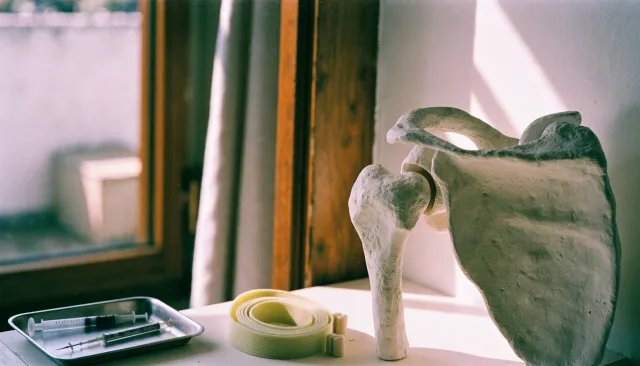
At the top of your shoulder, the rotator cuff tendons pass through a narrow tunnel under a bony roof called the acromion. A fluid-filled cushion, the subacromial bursa, sits in that space. When you raise your arm, those tissues glide through the gap. In impingement, that gliding becomes painful: the tendons and bursa get pinched and inflamed against the bone.
The story patients describe is usually consistent:
- A painful arc: lifting the arm out to the side hurts most through the middle of the range, then eases near the top.
- Catching overhead: reaching up to a shelf, hanging clothes, or doing your hair brings on a sharp pinch.
- Night pain, especially when lying on the affected side.
- Pain that refers down the outer upper arm, not usually past the elbow.
Impingement is best thought of as a description of a pattern of pain, not a single mechanical fault that one trim of bone will cure. Often the real driver is how the cuff and shoulder blade are working, which is exactly why rehabilitation can change the picture.
The operation, and what it was supposed to do
Arthroscopic subacromial decompression is keyhole surgery. Through small incisions, the surgeon shaves a little bone off the underside of the acromion and clears inflamed bursa, with the aim of making more room for the tendons. The logic is simple: more space, less pinching, less pain. For years it was one of the most commonly performed shoulder operations in the world.
Then it was put to a proper test, and the result is the reason this whole post exists.
When researchers compared the operation against a fake operation, the patients who had real surgery did no better. The shoulder did not know whether it had been decompressed.
The evidence: surgery versus a sham, and versus exercise
The strongest evidence we have is the FIMPACT trial (Paavola and colleagues), a randomised, placebo surgery controlled study with 5-year follow-up. This was 210 patients aged 35 to 65 with a clear impingement picture, split into three groups: real arthroscopic decompression, a diagnostic (placebo) arthroscopy where the surgeon looked inside but did not decompress, and a structured exercise programme.
At five years, the result was clear and humbling. Decompression gave no meaningful benefit over the placebo operation, and no meaningful benefit over exercise therapy, for either pain or function. That is about as clean a test as surgery ever gets, because the placebo group controls for everything a real operation also delivers: the anaesthetic, the rest, the attention, the expectation of getting better.
Surgery vs exercise: what the trial showed
FIMPACT, 5-year placebo surgery controlled RCT, 210 patients aged 35 to 65
No added benefit
Arthroscopic decompression did not beat a placebo (sham) operation for pain or function at 5 years.
Surgery vs placebo surgeryNo added benefit
Decompression also gave no meaningful advantage over a good structured exercise programme.
Surgery vs exerciseSource: Paavola M, et al. FIMPACT 5-year follow-up, British Journal of Sports Medicine, 2020.
This does not mean people in the trial did not improve. Many did. It means the improvement was not coming from the bone trimming. It was coming from time, from rehabilitation, and from the natural settling that impingement often shows. If exercise gets you to the same place as an operation, with none of the surgical risk, the choice is not a hard one.
The honest part
A trial result like this does not make the surgeon look good, and that is exactly why it matters. I would rather quote you the study that questions the operation than the one that sells it. Honesty is the only foundation a second opinion is worth anything on.
So what should you do first? The step-care ladder
For typical impingement, treatment should climb a ladder, and you should not skip the early rungs just because they are slower. Here is the order I follow with patients.
Conservative care, in order
- 1Confirm the diagnosis. A careful examination, and imaging where needed, to make sure this really is impingement and not a cuff tear, frozen shoulder, or a neck problem in disguise.
- 2Structured physiotherapy. A progressive, supervised programme to retrain the rotator cuff and shoulder blade. This is the single most important step, not an afterthought.
- 3Activity modification. Temporarily adjusting the overhead loads that flare your shoulder, while you build strength, so the tissues can settle.
- 4A considered injection, sometimes. A single subacromial injection can calm a painful shoulder enough to let you do the rehabilitation properly. It is a tool to enable exercise, not a substitute for it.
- 5Give it real time. Commit to a properly structured programme for at least three months before surgery is even discussed. Most people turn the corner inside that window.
When surgery still has a role
I do not want to swing too far and pretend the arthroscope is useless. It is not. The point of the evidence is narrow but important: for typical impingement pain in an otherwise sound shoulder, decompression on its own does not earn its place. There are still situations where keyhole surgery genuinely helps, and they have one thing in common: there is a real, fixable problem to address, or proper conservative care has genuinely failed.
- A rotator cuff tear that needs repair. If the imaging and examination show a tear that warrants fixing, that is a different operation with a different rationale, and decompression may simply be part of accessing it.
- A clear structural cause found on careful assessment, where the mechanical problem and your symptoms genuinely match.
- Genuine failure of good conservative care, meaning a proper, supervised, progressive programme that was actually completed, not a handful of half-hearted weeks.
If you fall into one of these groups, the conversation changes, and keyhole surgery becomes a reasonable option. You can read more about how the procedure itself works on my shoulder arthroscopy page. The skill in shoulder care is not in being able to operate. It is in knowing which shoulder in front of you actually needs it.
Getting an honest answer in Kannur
I am Dr. Vishnu Baburaj, a consultant orthopaedic surgeon (MS Orthopaedics, PGIMER Chandigarh; MRCS, UK), and I run a shoulder clinic at Aster MIMS Hospital, Kannur, where keyhole shoulder surgery is available when it is genuinely the right call. I see patients from across North Kerala and Malabar, including Thalassery, Payyannur, Taliparamba, Mattannur and Iritty.
If you have been offered subacromial decompression and something about it does not sit right, that instinct is reasonable. You can book a consultation at the clinic for a careful assessment, or arrange a second opinion before you commit to an operation. A good shoulder, more often than not, can be earned back through proper rehabilitation rather than surgery.