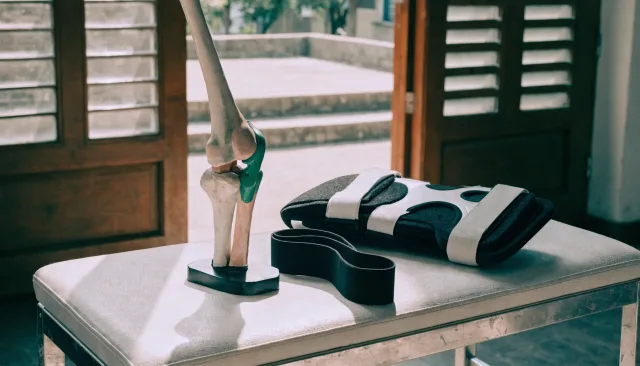
People-free sports-medicine still life with anatomical models, imaging and rehabilitation equipment illustrating Patellar (Kneecap) Dislocation: Why It Recurs and How to Stop It

Sports Medicine | Patient Guide

Patellar Dislocation:
Why It Recurs

Why a kneecap keeps slipping out, what the recurrence risk really is, and how to stop the cycle.

Sep 24, 2026 8 min read

On this page

Key Takeaways

  • After a first dislocation, the kneecap dislocates again in roughly a third of younger patients managed without surgery.
  • Most first dislocations are treated without surgery: protect, then rehabilitate.
  • Recurrence is driven by anatomy (a shallow groove, high or outward-sitting kneecap) and young age.
  • When it keeps happening, surgery to restore the restraint (often MPFL reconstruction) protects the cartilage long term.

A teenager lands awkwardly during a game, the knee buckles, and the kneecap visibly jumps to the outer side of the knee before slipping back. It is dramatic and painful, and the first question afterwards is always the same: will it happen again? For some people it never does. For others it becomes a recurring problem that steals their confidence in the knee. The difference is mostly about anatomy, and understanding it is the key to stopping the cycle.

What actually happens in a kneecap dislocation

The kneecap (patella) normally glides up and down in a groove at the end of the thigh bone, called the trochlear groove. When it dislocates, it almost always slips towards the outer side of the knee. As it does, it tears the main soft-tissue restraint on the inner side, the medial patellofemoral ligament (MPFL), which is the structure that normally stops the kneecap drifting outwards. Sometimes a flake of bone or cartilage is knocked off as the kneecap relocates, which matters because a loose fragment can need surgery in its own right.

So how likely is it to recur?

This is where honest numbers help. According to a systematic review of children and adolescents indexed on PubMed, the kneecap dislocated again in about 31 percent of knees managed without surgery, compared with about 22 percent of those managed surgically. In other words, after a first dislocation treated with rehabilitation alone, roughly one in three younger patients will have it happen again. The same review found that two anatomical features in particular raise the risk: a shallow or poorly formed trochlear groove (trochlear dysplasia) and skeletal immaturity, meaning the bones are still growing.

Recurrent dislocation in children and adolescents

Systematic review · via PubMed

≈31%

dislocated again after non-surgical (rehabilitation) management

Roughly one in three

≈22%

dislocated again after surgical management in the same review

Lower, but not zero

Trochlear dysplasia and skeletal immaturity were linked to higher recurrence risk.

Why some kneecaps keep slipping out

Recurrence is rarely bad luck. It usually reflects how the knee is built. The common reasons a kneecap is unstable include:

Anatomy that predisposes to recurrence

  • A shallow trochlear groove (trochlear dysplasia), so the kneecap has no deep track to sit in.
  • A high-riding kneecap (patella alta) that sits above the groove for longer.
  • A kneecap that tracks too far outward, often measured on a scan.
  • Loose ligaments or generalised flexibility, and rotational alignment of the limb.
  • A previously torn MPFL that has healed loose, leaving less restraint than before.

When several of these are present, especially in a young, active person, the kneecap has little holding it in place, and each dislocation makes the next one easier. That is the cycle we want to break.

Every time a kneecap dislocates, it can damage the cartilage. Stopping recurrent instability is not just about comfort and confidence; it is about protecting the joint for the decades ahead.

How we stop it

For a first dislocation, the answer is usually not surgery. We protect the knee briefly, control swelling, and then focus on physiotherapy to rebuild the quadriceps and hip muscles, restore control, and retrain the knee. Many people never dislocate again. Where a loose fragment of bone or cartilage has broken off, that may need arthroscopic treatment regardless.

When the kneecap keeps dislocating despite good rehabilitation, surgery shifts the odds firmly in your favour. The most common procedure reconstructs the torn MPFL with a graft to re-establish the inner restraint. If the bony alignment is a major driver, that may be corrected at the same time, for example by adjusting where the kneecap tendon attaches. The right combination depends entirely on your anatomy, which is why imaging and a careful assessment come first. You can read more about keyhole knee procedures on the knee arthroscopy page.

What I would tell a worried parent or athlete

A single kneecap dislocation is common and often a one-off, so do not assume the worst after the first event. Commit to the rehabilitation, because it genuinely reduces the chance of recurrence. But if the kneecap starts going out repeatedly, do not keep pushing through it. Each dislocation risks the cartilage, and at that point a proper assessment of why your knee is unstable, and a targeted operation to fix it, is the way to protect the joint and get your confidence back.

The evidence behind this article

Journal findings retrieved via PubMed.

  1. Nwachukwu BU, So C, Schairer WW, Green DW, Dodwell ER. Surgical versus conservative management of acute patellar dislocation in children and adolescents: a systematic review. Knee Surgery, Sports Traumatology, Arthroscopy, 2015. Recurrent dislocation occurred in about 31% of conservatively managed knees versus about 22% of surgically managed knees; trochlear dysplasia and skeletal immaturity raised the risk. doi.org/10.1007/s00167-015-3948-2

Findings sourced via PubMed. Surgical choices reflect standard orthopaedic practice and depend on individual anatomy. This article is educational and does not replace a consultation.

VB

Dr. Vishnu's Perspective

A first kneecap dislocation is frightening but often settles with good rehabilitation. What I watch for is the pattern: the patient whose kneecap goes out again and again. Repeated dislocations damage the cartilage each time, so once instability is established, fixing the cause is about protecting the joint for the long term, not just stopping a painful event.

Related Procedure at Aster MIMS Kannur

ACL Reconstruction & Sports Surgery

Candidacy, the surgical journey, recovery timeline, and booking.

Frequently Asked Questions

Will my kneecap dislocate again after the first time?

It might. In studies of children and adolescents, the kneecap dislocated again in roughly a third of those managed without surgery. The risk is higher in younger patients and in those whose knee anatomy makes the kneecap unstable, such as a shallow groove for the kneecap to run in. After a first dislocation, good rehabilitation reduces the chance of it happening again, but it does not remove it entirely.

Do I need surgery after a kneecap dislocation?

Not usually after a first-time dislocation. Most first dislocations are treated without surgery: a short period of protection, then physiotherapy to rebuild strength and control. Surgery is considered when the kneecap keeps dislocating despite good rehabilitation, when a loose fragment of bone or cartilage has broken off, or when the anatomy strongly predisposes to repeated dislocation.

What is an MPFL reconstruction?

The medial patellofemoral ligament (MPFL) is the main soft-tissue restraint that holds the kneecap from slipping outwards. It is usually torn during a dislocation. When the kneecap keeps dislocating, reconstructing this ligament with a graft re-establishes that restraint. It is often combined with addressing any bony alignment problem. The right operation depends on your specific anatomy.

Why does my kneecap keep slipping out?

Some people are simply built in a way that makes the kneecap less stable: a shallow trochlear groove, a high-riding kneecap, a kneecap that sits too far to the outside, loose ligaments, or rotational alignment of the limb. Add a torn MPFL from a previous dislocation and the kneecap has less holding it in place. This is why recurrence is common in some patients and rare in others.

Where can I get a recurrent kneecap dislocation assessed near Kannur?

I assess and treat patellar instability at Aster MIMS Hospital, Kannur, for patients across North Kerala. Bring along any previous X-rays or scans. We work out why your kneecap is unstable, whether structured physiotherapy is enough, and if surgery is needed, which procedure fits your anatomy. You can book a consultation through the clinic.

Medically reviewed by Dr. Vishnu Baburaj, MS Ortho (PGI Chandigarh), MRCS (UK) · Last reviewed

This article is for educational purposes and does not replace a medical consultation. For personalised advice, book an appointment at Aster MIMS Kannur.

Still Have Questions?

Discuss Your Case with Dr. Vishnu

Every patient is different. If you'd like personalised advice about your condition, book a consultation or send a message.

WhatsApp Us Request an appointment