Almost every frozen shoulder I see gets better without an operation. I want to say that first, plainly, because the moment the word "surgery" enters the room, patients assume it is the destination. It is not. For the great majority, time, physiotherapy and sometimes a well-timed injection do the job. This article is for the small group for whom that has genuinely not been enough, and for everyone trying to understand where the surgical line actually sits.
If you have not already, it is worth reading the companion piece first, on what a frozen shoulder is, how long it lasts and which non-surgical treatments earn their place. That post is the foundation. This one picks up exactly where it ends: at the refractory shoulder that stays both stiff and painful despite a fair trial of conservative care.
When conservative care has genuinely run its course
The most common reason a frozen shoulder ends up in a surgeon's clinic is not that surgery was always going to be needed. It is that the simple things were never properly tried, or were abandoned too early. Before I will even discuss an operation, I want to know that the basics have had a real chance. So this is the checklist I run through with every patient.
Have you tried these first?
- A confirmed diagnosis, with other causes of a stiff, painful shoulder ruled out.
- A genuine course of physiotherapy, done consistently, not one or two sessions abandoned because it hurt.
- Pain controlled well enough to sleep and to actually do the rehabilitation.
- An intra-articular steroid injection considered or tried during the early, painful phase, when it helps most.
- Blood sugar checked and, if you have diabetes, reasonably controlled.
- Enough time given. A frozen shoulder is slow, and most are still improving for many months.
If you can tick most of those boxes and the shoulder is still painfully stuck, generally past about six to nine months, then we have a refractory frozen shoulder, and a procedure becomes a fair thing to weigh. This is also where keyhole shoulder surgery enters the picture, so it helps to understand the two options on the table.
Surgery does not cure a frozen shoulder faster than the body would have. It frees a shoulder that has refused to free itself, for the small number in whom waiting longer is no longer the kinder choice.
The two procedures for a refractory frozen shoulder
When surgery is warranted, there are two main approaches, and they reach the same goal by different routes. The first is manipulation under anaesthesia (MUA). With you asleep and your muscles fully relaxed, the surgeon moves the arm firmly and deliberately through its range, breaking down the tight, scarred capsule that has been holding the joint hostage. It is quick and uses no incisions, but it relies on controlled force.
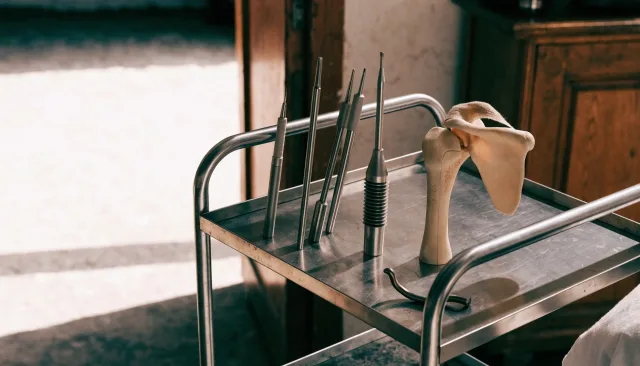
The second is arthroscopic capsular release (ACR). Through small keyhole incisions, the surgeon passes a camera and fine instruments into the joint and precisely cuts the thickened capsule under direct vision, releasing it in a controlled, targeted way rather than tearing it. It is the more technical of the two, and it lets the surgeon see exactly what is being divided. Here is how they compare.
Two routes to the same goal
Manipulation under anaesthesia vs arthroscopic capsular release
Manipulation (MUA)
Controlled force, no incisions
- Quick, no surgical cuts to the joint.
- More cost-effective in the Indian trial.
- Relies on force; small risk of arm-bone fracture or cuff tear.
- The release is not under direct vision.
Arthroscopic release (ACR)
Controlled cutting, keyhole
- Capsule divided precisely, under direct vision.
- Slightly better long-term pain score (not clinically meaningful).
- Higher rate of severe complications.
- More technical; needs keyhole equipment and skill.
Comparison drawn from the evidence cited below. Both are typically followed by the same structured physiotherapy.
What the evidence honestly shows
This is the part patients most want, and where I am most careful to give you the real picture rather than a sales pitch. If you go looking, you will find surgeons who strongly favour one technique over the other. The better-quality evidence is more even-handed than those opinions suggest.
A 2024 systematic review with meta-analysis pooled eight studies and 768 patients comparing arthroscopic capsular release with manipulation under anaesthesia for refractory frozen shoulder. It found comparable pain relief, comparable function and comparable range of motion between the two. Arthroscopic release did show a slightly better long-term pain score, but the authors were clear that the difference did not reach the threshold for clinical importance, in other words, it was a difference a patient would not actually feel. At the same time, arthroscopic release carried a higher rate of severe complications.1
The honest part
It would be easier to sell you the keyhole operation as clearly superior. It is more sophisticated, it looks more precise, and it is the one with my name on it as a shoulder arthroscopist. But the evidence does not support that story. The pooled data put the two procedures broadly level on the things you care about, pain, function and movement, and where arthroscopic release edged ahead on pain, the gap was too small to feel. It also came with more serious complications.
Closer to home, a randomised controlled trial from Coimbatore, the most directly relevant Indian evidence we have, found both procedures gave good improvement in pain and shoulder function with no significant difference at 24 weeks, and that manipulation was the more cost-effective option. So I will not pretend one is a clear winner. I will help you choose the right one for your shoulder, not the most impressive one.
That Indian randomised trial2 adds one more honest detail that matters here in North Kerala, where diabetes is so common: diabetic patients tended to gain a little less movement after the procedure than non-diabetic patients. It does not mean surgery fails in diabetes, it usually still helps meaningfully, but it tempers expectations, and it is one more reason to have blood sugar reasonably controlled going in. You can read more about the strong link between diabetes and frozen shoulder in the companion article.
So how is the choice actually made?
When the evidence puts two options broadly level, the decision becomes individual rather than dogmatic. In practice, the things I weigh are these. How stubborn and dense the capsule appears to be, because a very tight shoulder may benefit from the precision of a release rather than relying on force. Whether there is anything else going on inside the joint worth inspecting, since arthroscopy lets me look as well as treat. Bone quality and any factors that would make manipulation riskier, since the small fracture risk of MUA matters more in some patients than others. And, frankly, cost and access, because manipulation is the more economical route and that is a legitimate consideration for many families.
For a straightforward refractory frozen shoulder with no other concern, manipulation is a perfectly reasonable, evidence-backed and cost-effective choice. For a particularly dense capsule, a shoulder I want to inspect directly, or a patient in whom I would rather not rely on force, arthroscopic release earns its place. Neither is a default. Both are tools, and the skill is in matching the tool to the shoulder in front of me.
Whichever route we take, the operation is only the beginning. A capsule that has been freed can stiffen again if it is not used, so early, structured physiotherapy is not optional, it is the half of the treatment that holds everything the surgery achieved. I tell my patients plainly: how diligently you do the rehabilitation will matter as much as which procedure we chose.