When I tell a patient their shoulder problem can be handled with arthroscopy, the word itself often does more worrying than reassuring. It sounds technical and a little intimidating. So let me translate it straight away: arthroscopy simply means keyhole surgery, where we look inside the joint with a tiny camera and treat the problem through a few small cuts rather than one big one. Once that lands, most of the anxiety eases. This guide walks you through what it is, how it works, what it can and cannot fix, and what a typical operation actually looks like.
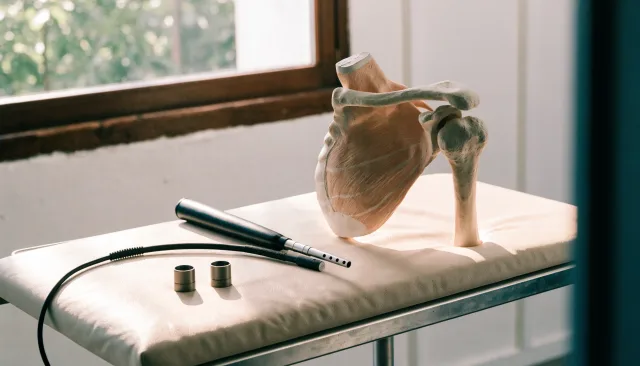
The word comes from two Greek roots: arthro, meaning joint, and skopein, meaning to look. So an arthroscope is, quite literally, a "joint-looker." It is a slim rod, around the width of a pencil, with a light and a high-definition camera at its tip. Slide it into the shoulder through a small incision and it sends a bright, magnified picture of the inside of the joint to a screen in the operating theatre. The surgeon operates while watching that screen, guiding instruments that come in through separate small incisions.
How keyhole surgery differs from open surgery
For most of the twentieth century, operating inside a shoulder meant opening it: a single larger incision, with the muscle and soft tissue moved aside to expose the joint directly. Open surgery is far from obsolete and still has its place. But the arthroscope changed what was possible, because it let surgeons see and work inside the joint without having to open it up to get there.
The practical differences matter to you as a patient. Smaller incisions mean smaller scars. Less cutting through and retracting of muscle means less soft-tissue disruption, which often translates to less early discomfort. And because the procedure is less invasive, shoulder arthroscopy is frequently done as day-care surgery, where you go home the same day. The magnified camera view is a genuine advantage too: structures deep inside the joint are often seen more clearly on the screen than with the naked eye through an open wound.
Open surgery
- One larger incision to reach the joint
- More soft tissue moved aside to see directly
- Direct, naked-eye view of the joint
- Still the right choice for some problems
Keyhole (arthroscopy)
- A few small, buttonhole-sized incisions
- Less soft-tissue disruption
- Magnified camera view on a screen
- Often day-care, smaller scars
One caveat is worth stating plainly: smaller cuts are not the same as a smaller operation. If a tendon is repaired or a joint stabilised, that is real surgery and recovery still takes time, whether the work was done through a keyhole or an open wound. The skin heals quickly; the structure underneath sets the pace.
What arthroscopy can diagnose and treat
Arthroscopy is genuinely versatile, which is why it has become a workhorse of shoulder surgery. Because the camera magnifies the inside of the joint, it is one of the most precise ways to confirm exactly what is wrong when scans leave some doubt. And in the same sitting, many of those problems can be treated. Commonly, that includes:
- Rotator cuff tears. The torn tendon is re-attached to the bone with small anchors, all through the camera.
- An unstable or dislocating shoulder. When the shoulder keeps slipping out, the torn rim of the socket (the labrum) can be repaired, often called a Bankart repair.
- Stiff or frozen shoulder that has not settled with injections and physiotherapy, where the tight capsule can be released.
- Labral and biceps problems, including certain SLAP tears, managed according to your age and activity.
- Clearing out loose fragments, inflamed tissue, or rough surfaces that catch and grind.
If you want to go deeper on two of these, I have written separately about whether a rotator cuff tear actually needs surgery and about what causes frozen shoulder and how long it lasts.
How a shoulder arthroscopy works, step by step
People are usually reassured to know the rough sequence of the day. Here is what a typical keyhole shoulder operation looks like from the moment you arrive.
The procedure, on one page
A typical day-care shoulder arthroscopy, start to finish
-
1
Anaesthesia
You are given a general anaesthetic so you are fully asleep, usually combined with a nerve block that numbs the shoulder and keeps you comfortable for hours afterwards.
-
2
Positioning and the first incision
You are positioned to open up the joint. A small incision is made and the arthroscope is slid in. Sterile fluid gently expands the joint for a clear view.
-
3
A guided look around
The magnified picture appears on the screen. The surgeon inspects the cartilage, tendons, labrum, and biceps, confirming the diagnosis before treating anything.
-
4
The treatment
Through one or two more small incisions, fine instruments repair, release, or tidy up the problem, for example re-anchoring a torn tendon or releasing a tight capsule.
-
5
Closing up and recovery
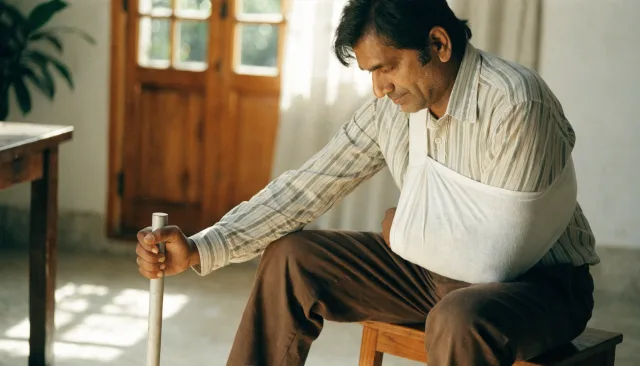
The instruments come out, the small incisions are closed with stitches or tapes, and a dressing and often a sling are applied. You wake in recovery and, in many cases, go home the same day.
The whole sequence is quieter than most people imagine. There is no large wound to dramatise, and because the camera does the looking, the surgeon can be precise while keeping the disturbance to the joint to a minimum.
At a glance
Shoulder arthroscopy at a glance
Incisions
A few small, buttonhole-sized cuts
Anaesthesia
Usually general, often with a nerve block
Stay
Often day-care; sometimes one night
Recovery
A sling for a few weeks after repairs, then staged physiotherapy
Used for
Cuff tears, instability, stiffness, labral problems
Where
Aster MIMS Hospital, Kannur, North Kerala
The honest part: a tool, not a cure for every shoulder
Here is the point I most want you to leave with. Arthroscopy is a beautifully precise way to get inside a shoulder and fix what genuinely needs fixing. But the keyhole itself does not make an operation the right answer. The honest truth is that not every painful shoulder needs surgery at all.
The skill is not in making smaller cuts. It is in knowing which shoulders need an operation and which will do just as well without one.
Shoulder impingement is the clearest example. For years, a common keyhole operation was to shave away a little bone to make more room under the shoulder (subacromial decompression). Then a carefully designed randomised trial put it to the test, comparing the real operation against a placebo "look only" arthroscopy and against exercise therapy alone. At five years, the decompression gave no benefit over the placebo procedure and no benefit over exercise for pain or function. In other words, for that particular problem, the keyhole operation did not beat doing physiotherapy or, frankly, doing very little surgically at all.
The honest part
This does not mean arthroscopy is overused or unhelpful. It means the technique and the decision are two separate questions. For a torn cuff, an unstable shoulder, or a stuck frozen joint, keyhole surgery can be exactly the right tool. For others, good non-surgical care wins. A surgeon worth seeing will tell you honestly which group your shoulder is in.
It is also worth knowing that keyhole is not automatically superior to open or mini-open surgery for every job. For rotator cuff repair, studies comparing all-arthroscopic with mini-open repair have found similar results in function, pain, and re-tear rates. The best operation is the one matched to your specific problem, not the one with the smallest scar.
Keyhole shoulder surgery in North Kerala
I perform shoulder arthroscopy at Aster MIMS Hospital, Kannur, where patients come from across Malabar, from Thalassery and Payyannur to Taliparamba, Mattannur, and Iritty. My training in shoulder and orthopaedic surgery (M.S. Orthopaedics, PGIMER Chandigarh; MRCS, UK) sits behind every one of these decisions, but the most important part of any consultation is honest: working out whether your shoulder needs surgery at all, and if it does, which operation suits it best.
If you have shoulder pain, weakness, stiffness, or a shoulder that keeps slipping, and you would like a clear answer about whether keyhole surgery could help, you are welcome to book a consultation at the clinic. Bring any scans you already have. Often the most useful thing I can tell a patient is exactly what they hoped to hear: that their shoulder can get better without an operation.