On this page
Start with the clinical story
Write a short timeline. Include why the first replacement was performed, the date and place of every operation, whether the joint ever felt well, and when the current symptoms began. Record any wound drainage, fever, falls, dislocations, fractures, giving way or stiffness.
Add your current walking ability, aids, pain pattern and main goal. A neat one-page timeline is more useful than a large folder with no order.
Essential records for every revision review
- All operation notes and discharge summaries
- Implant stickers, implant card, manufacturer, model and sizes where available
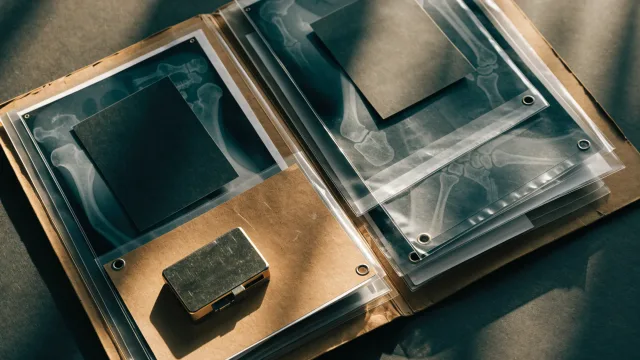
- X-rays from before and after the first operation, plus later comparison films
- Original DICOM files for recent X-rays, CT or MRI
- Blood results, aspiration reports, cell counts and culture reports
- A complete antibiotic history, including dates and reason
- Current medicines, allergies and major medical conditions
- Details of previous revisions, washouts or wound procedures
A one-page record that can travel with you
The printable records checklist and operation timeline has space for each operation, aspiration, antibiotic course and symptom change, with a simple available / missing / requested inventory. Keep the original reports alongside it. If a date or implant detail is uncertain, mark it as uncertain.
Send the records you have. The reviewing team should identify which gaps could change the plan and help establish where those records may be obtained.
How to obtain DICOM images
Ask the radiology department for the complete study in DICOM format. It may be supplied on a disc, secure download or patient portal. A compressed folder is acceptable if it contains the original files and viewer information. A phone photograph, screenshot or written report alone does not provide the same detail.
Keep the report as well. The report and images serve different purposes.
Organise the files so they can be understood
Create one folder for operations, one for laboratory and culture results, and one for imaging. Name each file with the date and body part. A simple index can list the primary replacement, later procedures, aspiration dates and courses of antibiotics.
If a record is not in English, keep the original and add a professional or reliable medical translation. Do not discard the original wording. Implant catalogue numbers and organism names should be copied exactly.
Why earlier X-rays are valuable
A single film shows one moment. Serial images can show progressive movement, wear, bone loss or a fracture developing. They also help identify which findings were already present when the implant was functioning well. [2]
Which imaging may be requested?
| Study | Possible purpose |
|---|---|
| Standing X-rays | Alignment, fixation, wear, bone loss and fracture |
| Long-leg or special views | Selected alignment or component questions |
| CT | Bone loss, component position or fracture detail |
| MRI with metal-reduction technique | Selected soft-tissue or adverse-reaction questions |
| Nuclear imaging | Selected unresolved cases, interpreted with the full work-up |
The list is not a standard test package. The examining surgeon decides what is needed after reviewing the clinical question and existing material. [2]
Infection records need special care
Send every ESR, CRP, aspiration, synovial test and culture result you have. State whether you were taking antibiotics when the sample was collected. Include the organism and sensitivity report if a culture was positive.
Do not stop antibiotics or anticoagulants because of something read online. If a new aspiration is being arranged, the treating clinician will decide how medicines should be managed. A patient who is acutely unwell needs treatment, not a delayed overseas work-up. [1]
What may be repeated in India?
Even a complete overseas work-up may not replace current standing radiographs, examination, blood tests or aspiration. Tests are repeated when their timing, quality or clinical context does not answer the present question. Anaesthetic clearance is always separate from the orthopaedic opinion.
Very old inflammatory markers do not describe today's joint. An aspiration performed after recent antibiotics may need careful interpretation. Images taken before a new fall may no longer answer the fracture question. Repetition should have a reason, and that reason should be explained.
Medical records are different from travel documents
The clinical review does not initially need every bank record or travel booking. Keep passport and visa material in a separate folder. This reduces the chance that the surgeon misses an important culture report inside a large administrative upload.
Once travel planning begins, the international team may request a passport page and details needed for a hospital letter. Send those only through the stated contact route.
Protect the record transfer
The team can help you share the records needed for review. Send them through the international contact route rather than posting identifiable medical information publicly.
Keep your own copy. The same record set will help the anaesthetist, physiotherapist and home clinician later.
Five possible outcomes of a remote review
- The symptoms may not come from the implant, and local assessment is advised.
- More records or tests are needed before travel is sensible.
- The case appears suitable for an in-person revision assessment.
- An urgent problem needs treatment in the country where the patient is located.
- A complex or staged pathway is possible and requires more time, components and planning.
Plan for uncertainty
A provisional plan may change after examination, aspiration, new imaging or findings during surgery. Bring a companion when appropriate, use flexible travel, and allow an accommodation buffer. Revision flight timing is also individual. An uncomplicated revision without infection is first reassessed for a flight longer than four hours at about four to six weeks or later. Infection-related or staged revision has no preset window.
The remote review may reasonably conclude that the patient should first attend a nearby revision centre. This is especially important when infection, fracture, dislocation, severe medical illness or inability to mobilise makes long travel unsafe.
Send records through the international patient form, email [email protected] or WhatsApp +91 80008 85008. The preliminary remote review is free. The scan-review guide explains the initial response target and how the team helps when records are missing.
What to carry when you travel
Carry the clinical timeline, original imaging access, operation notes, implant records and medicine list in hand luggage. Bring the contact details of the hospital that performed the earlier operations. If cultures were positive, include the full microbiology and sensitivity report rather than a message saying only “infection found.”
The final in-person consultation should end with a written diagnosis, proposed reconstruction, alternatives, likely restrictions and the circumstances that could change the plan.
Keep one copy of the record set with the companion and another secure digital copy. Do not place the only implant record or culture report in checked baggage. After surgery, add the new operation note, component labels and discharge documents to the same organised archive.