The direct anterior approach can offer some early recovery advantages after total hip replacement. It is not scarless, does not eliminate tissue injury and has its own risks. The surgeon's experience and the patient's anatomy are central to the choice.
I offer direct anterior hip replacement at Aster MIMS Kannur for suitable patients. The approach is chosen after assessing the hip, previous surgery and the reconstruction needed. Another route may give safer access in a particular case.
On this page
How is it different?
Every total hip replacement removes the damaged femoral head and resurfaces the socket. The components do not become “anterior implants”. The difference is the route used to reach the joint.
The direct anterior approach reaches the hip from the front through an interval between muscles. Posterior and lateral approaches use different planes. Each can provide a good hip replacement when chosen and performed well.
The patient may be positioned on a standard or specialised operating table, depending on the surgeon's technique. X-ray imaging may be used during the operation. These workflow choices are not proof that one exposure is universally better. They are parts of how the surgeon executes the planned reconstruction.
The approach does not choose the components
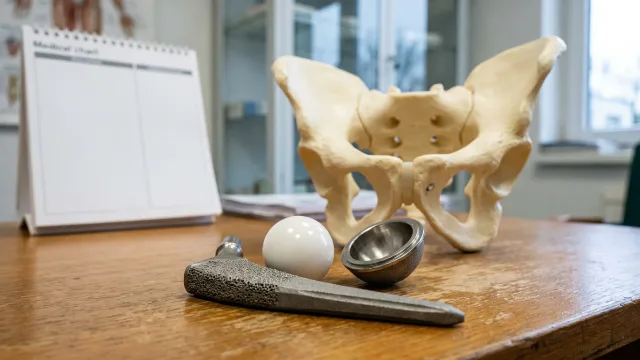
Hip stems, cups, liners and heads are selected from the patient's anatomy, bone quality, age, activity and diagnosis. Cemented and cementless fixation decisions are also separate from the skin route. There is no single “anterior implant”.
Component position matters whichever approach is used. The surgeon must restore stability, leg length and offset while protecting the bone and surrounding tissues. A smaller incision is not a substitute for those aims.
What early benefits have studies found?
A 2024 meta-analysis of 33 studies found lower pain scores on the first two days and a shorter hospital stay on average with the anterior approach. It also found more components within a commonly used radiographic safe zone. [1]
The same analysis found no clear difference in time to stop walking aids, dislocation, groin pain, incision problems, heterotopic bone formation or blood loss. Average early differences should not be turned into a personal recovery promise. [1]
What are the limitations?
The front of the hip is close to the lateral femoral cutaneous nerve, which supplies sensation to part of the outer thigh. Numbness, tingling or burning can occur when it is stretched or irritated. The cited review also reported a higher risk of intraoperative fracture in the anterior group. [1]
The approach has a learning curve. A systematic review found that operative time and complications improved as surgeons gained experience, although the studies and definitions varied. This is one reason to ask about approach-specific experience rather than choosing from a marketing label. [2]
What does thigh numbness mean?
The lateral femoral cutaneous nerve is a sensory nerve. Irritation can cause a patch of altered feeling, tingling or burning on the outer thigh. It carries sensation and does not control muscle strength. Symptoms can still be bothersome and may take time to settle. [3]
New weakness, severe pain or a rapidly changing symptom should not be self-labelled as expected numbness. It needs clinical assessment, particularly after the patient has travelled home.
| Question | Evidence suggests | Evidence does not establish |
|---|---|---|
| Early pain | Small average advantage in the first days | A painless operation |
| Hospital stay | Shorter average stay in pooled studies | The same discharge day for everyone |
| Walking | Early function can differ in some studies | Earlier independence for every patient |
| Dislocation | No clear difference in the cited meta-analysis | Zero dislocation risk |
Who may need another approach?
Previous surgery, unusual anatomy, major deformity, fracture, severe bone loss or a complex revision can affect access. Body build and implant requirements may matter too. These are not absolute online rules. The surgeon decides after reviewing the person and the reconstruction.
Changing the exposure to improve safety is not a lesser operation. The long-term aim is a stable, well-positioned hip with protected tissues and clear component records.
Questions about dislocation and precautions
The approach is only one part of hip stability. Component position, soft tissues, anatomy, muscle control and patient behaviour all matter. The cited meta-analysis did not establish a dislocation advantage for the anterior route.
Movement advice should come from the actual operation. Some patients receive specific precautions and others receive a more flexible plan. Internet rules aimed at a different approach or reconstruction should not override the discharge instructions.
What does recovery look like?
Patients usually begin mobilisation in hospital with a walking aid. Pain control, wound care, safe transfers and physiotherapy guide discharge. The usual inpatient pathway for an uncomplicated primary THR in this practice is three days.
At home or in local accommodation, progress is judged by function rather than the incision alone. Walking distance, confidence, swelling, pain and general medical recovery all matter. Exercises and restrictions should match the actual operation.
Typical milestones are not deadlines
Early goals include getting in and out of bed, using the bathroom, walking with the recommended aid and understanding the medicine and wound plan. Stairs are practised when the patient's accommodation requires them and it is safe to do so.
Later progress involves walking quality, strength, endurance and return to ordinary daily tasks. Driving, work and exercise depend on the operated side, vehicle, job and clinical review. An early average advantage in a study does not set an individual date.
What should be recorded after surgery?
International patients should take home the operation note, implant labels, postoperative imaging, discharge summary and rehabilitation guidance. The operation note should identify the approach and any specific precautions. This lets a local clinician interpret symptoms and organise follow-up without guessing.
International travel still needs its own review
The anterior approach does not provide a special flight rule. For a flight longer than four hours, the first reassessment after an uncomplicated one-sided THR is usually planned 14 to 21 days after surgery. The wound, mobility, blood-clot risk, medicines, other health conditions and route decide the advice.
Use the joint-replacement flight guide for planning. The hip cost guide separates the hospital package from accommodation and travel.
Questions to ask
- Why does this approach suit my hip?
- What are the alternatives?
- What approach-specific complications do you discuss?
- How often do you use this exposure for primary THR?
- What might make you change the plan?
- Which movement and wound criteria guide discharge?
- When will travel be reassessed?
The recommendation should connect your anatomy and reconstruction to an approach the surgeon can perform safely.