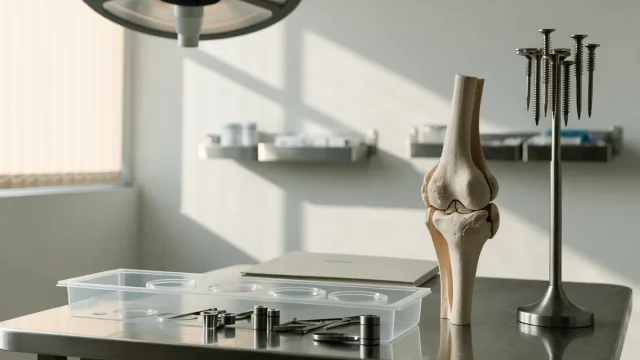
The word “robotic” can give the wrong picture. CORI does not decide that you need knee replacement, choose the implant or operate on its own. The surgeon remains responsible for every clinical and surgical decision.
On this page
What happens before the robotic part begins?
The process starts like any sound knee-replacement pathway. Your symptoms, examination and weight-bearing X-rays must support the operation. Non-surgical care should have become ineffective or unsuitable. The surgeon then decides whether total or partial replacement fits the pattern of arthritis.
Medical assessment and anaesthetic clearance come next. Robotic assistance changes how the plan is measured and carried out in theatre. It does not remove the ordinary work needed to decide whether surgery is appropriate.
How CORI maps the knee
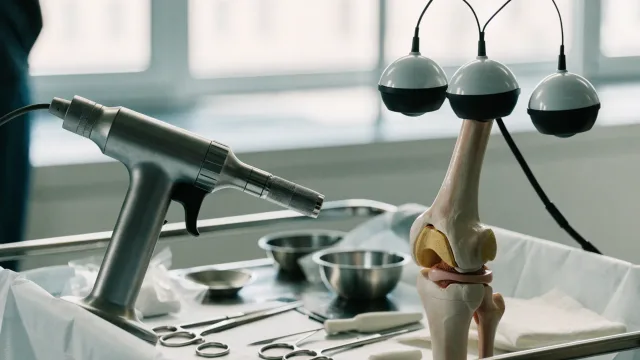
During surgery, small trackers allow the system to understand the position of the thigh bone and shin bone. The surgeon collects points from the joint surfaces and moves the knee through a range of motion. CORI builds a three-dimensional working map from that information. [3]
The map helps assess alignment, implant size and position. It also lets the surgeon see how proposed changes may affect the gaps and ligament balance through bending and straightening. The plan can be adjusted before the final bone preparation is completed. [3]
What “image-free” actually means
CORI does not require a preoperative CT scan to create its robotic map. That is the meaning of image-free. It does not mean a patient needs no imaging. [3]
Weight-bearing X-rays remain important for diagnosis and deciding between partial and total replacement. MRI or other studies may be needed when the problem is unclear. The technology avoids a CT-based robotic planning step; it does not make the clinical assessment image-free.
Who controls the bone preparation?
The surgeon holds and guides the handheld instrument. The system provides visual information and controlled boundaries based on the operative plan. The surgeon checks the bone, soft tissues, balance and implant trial before accepting the result. [3]
If the anatomy or findings require a change, the surgeon changes the plan. Conventional knee replacement remains an established alternative. At Aster MIMS Kannur, CORI is arranged when needed for the planned operation.
What the patient sees on the day
From the patient's point of view, much of the hospital pathway looks like any other knee replacement. There is an anaesthetic assessment, confirmation of the correct knee and procedure, infection-prevention checks and discussion of the implant plan. The extra robotic steps occur in the operating theatre.
Small fixation pins are used so the trackers can follow the thigh bone and shin bone. The surgeon registers anatomical points, checks the system's map and measures the knee through movement. Trial components are then assessed before the final implants are accepted. The computer display supports these decisions, but the surgeon still inspects and feels the knee.
The tracker pins pass through small skin openings into the bone. A pin site can become infected; a fracture through a pin hole is another reported complication. These risks are specific to the tracking equipment and belong in the consent discussion alongside the usual knee-replacement risks. Reports combine different navigation and robotic systems, so they do not provide a personal CORI complication rate. [4]
| What CORI does | What CORI does not do |
|---|---|
| Creates an intraoperative map | Diagnose arthritis by itself |
| Displays alignment and balance measurements | Choose total or partial replacement independently |
| Helps plan implant size and position | Select the final plan without the surgeon |
| Assists controlled bone preparation | Guarantee pain relief or recovery speed |
| Records operative measurements | Promise longer implant survival |
What has research shown?
Across robotic knee systems, randomised trials generally show more accurate restoration of planned alignment and fewer radiological outliers. Those findings concern surgical precision. Clinical scores and complication rates have often been similar to conventional knee replacement. [1]
A 2023 randomised trial included NAVIO, CORI and manual TKA. The robotic groups achieved more accurate femoral rotational alignment. The difference in knee scores did not reach the minimum size usually considered clinically important, and pain, range of motion and complications were similar at the reported follow-up. [2]
Results from one platform cannot automatically be transferred to another. Manufacturer descriptions are useful for explaining how CORI works, but they are not independent proof of better patient outcomes.
Precision and outcome are related, but not identical
Implant position and ligament balance matter. Robotics gives the surgeon more measurements while preparing the knee. Yet a technically accurate plan does not control every source of pain or stiffness. Nerve sensitivity, scar formation, muscle weakness, expectations and medical health can all affect recovery.
This distinction explains why research may find fewer alignment outliers without finding a large difference in patient scores. Better measurement is a reasonable surgical goal. It should be described honestly, without promising that every patient will walk sooner or prefer the robotic knee.
Who may be considered?
CORI can support selected primary total and partial knee replacements. Suitability begins with the operation itself. A patient must first have symptoms and arthritis that justify replacement, and partial replacement requires a suitable pattern of disease and ligament function.
Previous metalwork, severe deformity, major bone loss, active infection concern or a revision problem can change the available plan. Some cases need equipment or implants outside a primary robotic pathway. The record review should identify these issues early, but final suitability remains an in-person decision.
Does the robot choose the implant?
No. CORI works with compatible implant systems and the surgeon selects the appropriate components. Size, fixation, constraint and whether the kneecap surface is treated are clinical decisions. Patients should receive the implant labels and operation note after surgery.
If a particular manufacturer or model matters to the patient, it should be discussed before the estimate is accepted. The exact model and patient fit are more useful than a simple brand ranking.
Does robotics change recovery?
Recovery depends on pain control, swelling, preoperative strength, other health conditions, the operation performed and rehabilitation. Accurate execution is important, but it is only one part of that system.
The usual inpatient pathway for a primary replacement is three days. Robotic assistance does not create an automatic earlier discharge or flight date. International patients still need the same wound, mobility and blood-clot assessment described in the flight-safety guide.
The first practical goals remain safe transfers, walking with the recommended aid, knee movement, quadriceps activation and a manageable home plan. Patients should not chase a marketing milestone if swelling, pain or balance makes it unsafe.
Price and scheduling
Robotic assistance adds USD 600 once to the applicable package. The addition remains USD 600 for a bilateral package. The knee replacement cost guide explains the base ranges and what the planned hospital admission includes.
The date is confirmed after assessment, medical clearance and hospital scheduling. Patients who are not suitable for robotics can still have a carefully planned conventional knee replacement.
The decision to replace both knees during one admission is separate from the decision to use robotics. It needs its own medical and recovery assessment.
Questions worth asking
- Why is total or partial replacement being proposed?
- Which robotic system will be used?
- Does it require a preoperative CT scan?
- What decisions remain under the surgeon's control?
- Which implant system is planned?
- Is robotic assistance appropriate for my proposed operation?
- Is the added cost included in the written estimate?