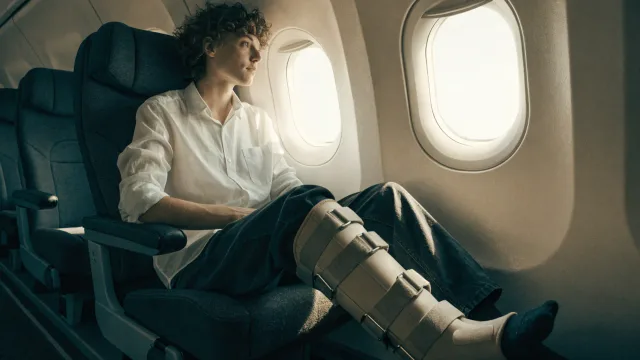
There is no single day on which every patient becomes safe to fly after knee or hip replacement. We use planning windows so an overseas patient can arrange accommodation and a flexible ticket. The final advice comes after reassessing the person, not after counting days on a calendar.
A short answer such as “fly after two weeks” leaves out the circumstances that decide the advice. Recent surgery and a long period of sitting both affect blood-clot risk. At the same time, the research on people who fly soon after joint replacement is limited and has not produced one agreed rule.
On this page
Why flying soon after surgery needs thought
A long flight keeps you seated in a small space. Leg movement falls, and blood flow through the veins slows. Joint replacement adds recent surgery, tissue healing and a period of reduced mobility. These risks do not mean every traveller will develop a clot. They mean the timing and prevention plan should be personal. [1]
There is no single standard definition of long-distance travel. The Centers for Disease Control and Prevention notes that more than four hours is the cutoff used most often when discussing travel-related venous thromboembolism. Recent surgery, older age, obesity, previous clots, active cancer, hormone treatment and limited mobility are among the factors that can raise risk. [1]
Flying also asks practical questions that clot guidance does not answer. Can you get through a large airport? Can you sit with the knee bent? Can you stand safely from a low seat? Is the wound dry? Is pain controlled without medicine that leaves you very drowsy? A difficult connection can matter as much as the time in the air.
What the research actually tells us
A 2025 review of air travel after total hip and knee replacement found only limited evidence. Most of the reported postoperative flights took place within seven days, and those studies did not show a clear difference in venous thromboembolism between patients who flew and those who did not. That does not prove an early flight is safe for everyone. The evidence is too limited to establish one safe date. [2]
A systematic review published in its 2026 journal issue combined retrospective studies of different operations and journeys. Its estimates were too imprecise to exclude a clinically important increase in clot risk, and differences between the groups could not be fully accounted for. It cannot establish a safe departure date. [3]
Advice from surgeons, hospitals and airlines still varies widely. Some guidance allows earlier travel for carefully selected patients, while other guidance recommends a much longer wait. The variation exists because strong evidence for a precise cutoff is missing.
A lack of proof that early flying is more dangerous is not the same as proof that it is safe for every patient.
The planning windows we use
The windows below are the first point at which travel is usually reassessed for a flight longer than four hours. They help with planning. They do not replace the clinical review.
| Operation | First reassessment window | Why it may be later |
|---|---|---|
| Uncomplicated isolated ACL reconstruction | 7 to 14 days | Meniscus repair, restricted weight bearing, marked swelling or added clot risk |
| One-sided UKA, TKR or THR | 14 to 21 days | Wound concern, anaemia, slow mobility, medical illness or a long route with several connections |
| Bilateral primary knee replacement | 21 to 28 days | Greater walking burden, swelling, pain, anaemia or other medical risk |
| Revision knee or hip replacement without infection | 4 to 6 weeks or later | Complex reconstruction, protected weight bearing or slower wound and medical recovery |
| Infection-related, staged or complicated revision | No preset window | Cultures, antibiotics, further surgery and clinical stability decide the timing |
The usual hospital stay is three days after a primary joint replacement. This is a different figure. Leaving hospital means you no longer need inpatient care. It does not mean you are ready for a long airport day and flight.
Arthroscopy is a method used for several different operations. A meniscus or cartilage repair can require restrictions that differ from an isolated ACL reconstruction, so its timetable must follow the actual procedure.
What can move the travel date?
The operation is only the starting point. Previous blood clots, cancer treatment, marked obesity, limited mobility and some hormone medicines can add to clot risk. Anaemia, a medical illness, heavy wound leakage, suspected infection or poor pain control may also make travel unwise. A patient taking an anticoagulant still needs the same clinical review because protection from clots comes with a bleeding risk.
The route matters too. A four-hour direct flight is different from several flights, long terminal walks and an overnight connection. Count the whole door-to-door period, including the drive to the airport and waiting time between flights.
Good progress may allow review at the earlier end of a planning window. It does not guarantee approval. If recovery is slower, the safest answer may be to extend the stay and review again. Build that possibility into the ticket and accommodation before surgery.
What I check before advising travel
The review is a short clinical assessment with a practical purpose. I want to know whether the journey is reasonable at that point in recovery.
Travel reassessment
- The wound is dry and secure, without concerning redness, drainage or fever.
- Pain and nausea are controlled, and medicines are stable.
- You can transfer safely, tolerate sitting and walk at intervals with the planned aid.
- There is no clinical concern about a blood clot, infection, fracture, dislocation or other complication.
- Your clot-prevention plan and other health conditions have been reviewed.
- The route, airport assistance, companion needs and airline rules have been considered.
If one of these points is not satisfactory, the answer may be to wait and review again. The plan should allow time for a further review.
Blood-clot prevention during the journey
Take the postoperative clot prevention prescribed for you. Do not add aspirin, double a dose or take an extra anticoagulant for the flight unless your treating clinician gives that instruction. These medicines can cause bleeding as well as prevent clots.
Frequent movement and calf exercises are reasonable during a long journey. An aisle seat can make movement easier. Properly fitted below-knee compression stockings may be advised for some higher-risk travellers, but they are not right for everyone. Ask before buying them.
Drink normally and avoid becoming dehydrated because it is sensible for comfort and general recovery. Hydration alone has not been proven to prevent travel-related clots. [1],[4]
Plan the airport, not only the aircraft
Book wheelchair or special assistance before travel if long walks are likely to be difficult. That service helps with the airport. It is not a medical escort. If you cannot bend the knee enough for a standard seat or cannot transfer safely, speak to the airline before booking.
Choose a route with enough connection time. A rushed transfer through a large terminal is a poor test of a new joint. Keep medicines, discharge records and essential aids in hand luggage. Carry the airline's medical form or factual clinical letter if requested.
The airline makes the final decision about carrying a passenger. A clinical letter can state the operation date, present condition, mobility and assistance needs. It cannot promise that a flight has no risk. [5]
Build flexibility into the trip
A flexible return ticket and accommodation buffer cost more at the start, but they prevent a clinical decision from becoming a financial emergency. The aim is not to keep every patient in Kannur for the longest possible time. It is to avoid forcing a flight before the patient is ready.