On this page
Why local accommodation is part of recovery
After discharge, international patients often remain nearby while the wound, swelling, walking and flight readiness are reviewed. Follow-up is included and tailored to the case. The room becomes part of the recovery environment.
Near the hospital or farther away?
Staying near Aster MIMS Kannur reduces transport time for wound review or an unexpected concern. A town or resort location may offer more space or a different setting, but each journey to hospital is longer and may be uncomfortable early after surgery.
The exact room and the route to hospital matter more than the property's star rating. This guide helps you compare those details; it does not recommend an inspected hotel shortlist.
Ask for measurements and current photos
- Step-free entrance or number and height of steps
- Lift dimensions, reliability and backup during power interruption
- Door and corridor width for the expected walking aid
- Shower threshold, floor grip and available support
- Toilet height and space to turn
- Bed height and clearance around the bed
- Chair with arms and a firm seat
- Distance from vehicle drop-off to the room
A marketing label such as “accessible” does not answer these questions.
Match the room to the operation
The room needs to fit the operation and the movement advice. A low seat may be unsuitable for a person with hip precautions. A knee-replacement patient needs space for the leg and safe transfers; crutches or a frame also need clear routes. Revision restrictions may require a different setup.[1]
The discharge plan should describe the expected walking aid and any movement restrictions. Those details let a property or coordinator check the exact room, rather than assume every room in the building will work.
Think about everyday needs
Confirm meals that fit medical requirements, drinking water, refrigeration if medicines require it, laundry, room cleaning and companion space. Ask whether physiotherapy can be arranged in the room or whether transport is needed.
Hotel, serviced apartment or family home?
A hotel may offer regular cleaning and meals. A serviced apartment may provide more space, a kitchen and laundry. Staying with family can offer support, but the bathroom, stairs and distance from hospital still need the same check.
No category is automatically safer. The correct choice is the property that fits the walking aid, companion, clinical review schedule and likely length of stay.
Bathroom details deserve attention
A walk-in shower may still have a raised lip. A polished wet floor may be unsafe even when there are grab rails. Ask for a current photo showing the route, toilet, shower and available support. If a temporary aid is needed, confirm who supplies and fits it.
Check the bed and chair, not only the bathroom
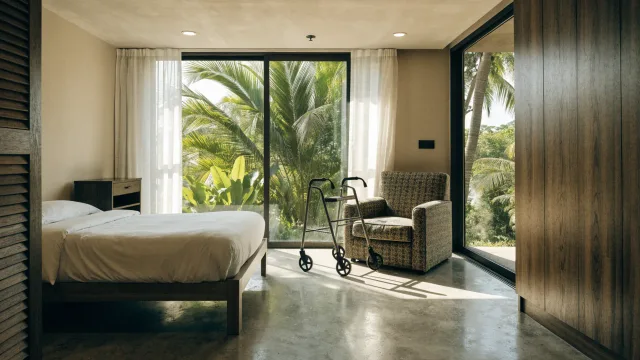
A very low bed or soft sofa can make standing difficult. Ask for a firm chair with arms and enough space to place the walking aid without blocking the route. The patient should not need to climb over luggage to reach the bathroom.
For hip replacement, the team should explain any seat-height or movement precautions that apply. Avoid making an unstable seat by stacking loose cushions.[1]
Transport and emergency access
Know how long the trip to hospital takes at ordinary and busy times. Confirm a vehicle that is easy to enter after the operation. Keep local emergency numbers and hospital contacts available.
A routine review may use planned transport, while an urgent problem needs a faster route. Ask whether the property can call a suitable vehicle at night and whether the entrance is easy for pickup.
Book flexibility
Choose cancellation and extension terms that match uncertain recovery. For an uncomplicated unilateral primary replacement and a flight over four hours, this practice generally plans the first reassessment 14 to 21 days after surgery. Bilateral knee replacement is generally 21 to 28 days or later. These are not fixed checkout dates.
Ask for the extension rate in writing and whether the same accessible room can be kept. Moving rooms during early recovery may be more difficult than paying for a slightly longer flexible reservation.
Nearness has two meanings
A short distance on a map can still involve heavy traffic, uneven access or a difficult vehicle transfer. Ask for the usual travel time and the pickup point at both ends. A reliable driver and simple route may be more useful than the closest straight-line distance.
How coordination works
Accommodation and transfers can be coordinated on request and incorporated into a custom package. The requirements should be described first. A property should not be presented as suitable for a mobility need until its access has been checked.
Plan how physiotherapy will happen
Some early sessions take place in hospital. After discharge, the plan may involve a return visit, an in-room session or exercises supervised by the companion only as instructed. Confirm the location and transport before choosing the room.
The space should allow safe transfers and the prescribed simple exercises. A swimming pool or gym is not a reason to choose a property unless the clinical team has approved their use.
Food and medicines need an ordinary plan
Check whether meals can be delivered at suitable times and whether dietary needs can be met. If a medicine requires refrigeration, confirm reliable storage. The patient should not have to walk to a distant restaurant for every meal.
Keep the prescription, medicine list and emergency contacts together. A family member should know which medicine questions need the clinical team rather than hotel staff.
Five questions to send the property
- Can you send current photos of the entrance, lift, bathroom and bed?
- Are there any steps between the vehicle and room?
- Will my expected walking aid fit through the doors and bathroom?
- Can the stay be extended at short notice, and on what terms?
- How quickly can transport to Aster MIMS Kannur be arranged?
Print the accommodation accessibility checklist for one record of the exact room, photos, access route and written booking terms. The property or coordinator can complete it with you.
Score the essentials before comfort extras
Place step-free access, bathroom safety, hospital travel, flexible extension and companion space at the top. Then compare food, laundry, quiet, internet and room comfort. A beautiful view cannot compensate for a bathroom the patient cannot enter safely.
Use the length-of-stay guide and companion guide to complete the plan.
Final room check before payment
- Current photos match the exact room category.
- The full vehicle-to-room route has been checked.
- The bathroom and seating fit the expected walking aid and precautions.
- Hospital travel time and night transport are known.
- Meals, laundry, medicines and companion needs are covered.
- Extension and cancellation terms are in writing.