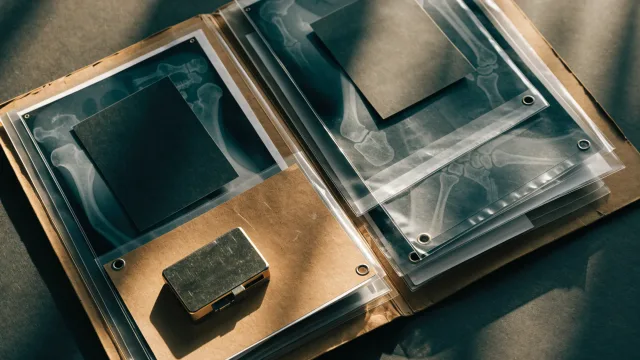
You do not need to fly to Kannur simply to find out whether an operation might be reasonable. A remote scan review can give you a useful first answer before you spend money on travel. It works best when the clinical story and the original images arrive together.
The remote review is free. Once the records are complete and readable, the initial-review target is 24 to 48 calendar hours. The word “initial” matters. This is a careful planning step, not a final diagnosis made through a screen.
On this page
First, tell us what is actually wrong
A scan does not show how much the joint affects your life. Two people can have similar X-rays and need very different treatment. One may still walk comfortably. The other may be waking with pain every night and struggling to work.
Start with a short account in your own words. Say where the pain is, how long it has been present and what makes it worse. Mention swelling, locking, giving way, weakness or numbness. Tell us what treatment you have tried and what you hope to return to. For an athlete, that may be football. For someone with arthritis, it may be walking to the shops or sleeping through the night.
What starts the clock
The 24 to 48 calendar hours target begins after the necessary history and readable images have arrived. The team helps identify anything missing. It concerns an initial review, not completion of every investigation.
Send the images, not only the report
The radiology report is useful. It gives the radiologist's reading of the study and may highlight an injury or area of concern. Still, it cannot replace direct review of the images. The exact location of arthritis, implant position, bone loss or a meniscus injury may need to be checked against your symptoms and previous studies.
Original DICOM files contain the complete imaging study. Share the images and reports you already have; the team helps identify anything missing. A few screenshots or photographs of printed films can lose detail.
Make the record set easy to understand
Earlier and recent records can help show what has changed. A short summary of your symptoms and previous treatment helps the team put the images in context.
Add a one-page summary with your age, affected side, diagnosis if known, previous operations, medicines, allergies and main question. State where and when each operation was done. For joint replacement, include the implant card or stickers if you have them. For a suspected infection, include any antibiotics and the dates they were taken. Do not stop prescribed antibiotics for the purpose of a remote review.
The record set depends on the operation
| Type of problem | Most useful records |
|---|---|
| Primary knee replacement | Recent weight-bearing knee X-rays, symptom history, treatments tried, medication list and medical conditions. |
| Primary hip replacement | Recent pelvis and hip X-rays, pain pattern, walking limitation, previous treatment and medical history. |
| ACL or sports-knee injury | MRI DICOM files and report, injury date, giving-way history, swelling, locking, sport or work demands and rehabilitation already completed. |
| Revision knee or hip replacement | Current and older X-rays, operation notes, implant stickers or card, discharge summaries, infection tests, culture results and antibiotic history. |
You can use the printable records checklist. Start with what you have; the coordinator can help identify missing items rather than making you repeat the whole submission.
Your medicines matter in every group. Include blood thinners, diabetes medicines, steroids and any drug allergy. Previous blood clots, heart or lung disease, kidney disease and past anaesthetic problems should be stated early.
What the first recommendation contains
Dr Vishnu reviews the available history and imaging to consider the likely problem, reasonable non-surgical and surgical options, and any missing tests. It should help answer whether travelling for an in-person assessment is worthwhile.
If surgery appears likely, the team can outline the expected procedure, usual hospital stay and estimated package. You can then discuss preferred dates, visa-support documents, transfer and accommodation. Robotic knee surgery is scheduled around clinical suitability, hospital capacity and CORI availability.
Sometimes the right reply is “not enough information yet”. That is not a poor result. It is safer than building an operation and travel plan on an incomplete scan.
If you choose to proceed, the hospital provides a dated written estimate for the proposed operation and package scope. Visa-support documentation, transfer and accommodation coordination and physiotherapy planning are available. Follow-up with Dr Vishnu is included as appropriate for your case.
The purpose of the review is to decide the sensible next step. It is not to force every scan toward surgery.
What cannot be decided online
A remote review cannot test ligament stability, feel where pain comes from or examine nerves and circulation properly. It cannot replace an anaesthetic assessment. In a painful joint replacement, it cannot rule out infection from appearance alone. [2]
New weight-bearing X-rays, blood tests, aspiration, CT or other investigations may be needed after you arrive. The in-person examination can confirm the provisional plan, change it or show that surgery should wait.
This is especially important for revision surgery. A loose implant, infection, instability and fracture need different treatment. Even excellent images may not show the full picture before examination and laboratory work.
Start with the records you have
You can begin through the orthopaedic second-opinion service or the international patient page. The team will help identify any further records needed for review.
Know when not to wait for an online reply
Remote review is for planned care. Urgent symptoms need hands-on assessment before the online pathway.