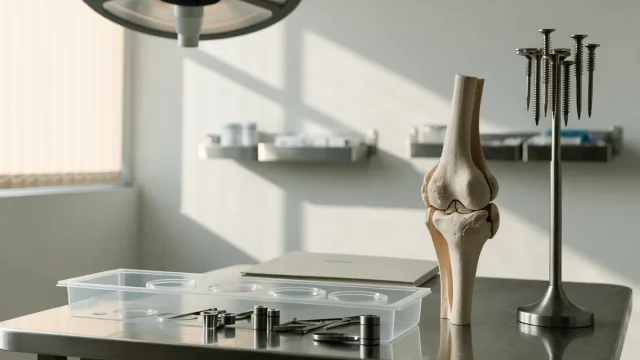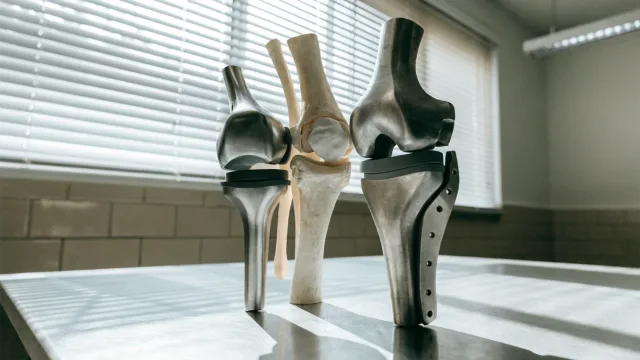
You may not need a total knee replacement if advanced arthritis is truly limited to one suitable compartment. A partial knee replacement preserves more of the patient's own bone, the unaffected compartments and the central ligaments. It is not appropriate when the disease is more widespread.
On this page
Partial and total replacement treat different knees
The knee has medial, lateral and kneecap compartments. Many people develop arthritis mainly on the inner, or medial, side. If symptoms, examination and weight-bearing X-rays all point to isolated disease, UKA may be considered.
Total knee replacement resurfaces the main joint areas that require treatment. It is generally the safer choice when arthritis affects several compartments, deformity is not correctable, the ligaments are unsuitable or inflammatory disease affects the knee more widely.
What makes partial replacement plausible?
Pain is often focused on one side of the joint, but pain location alone cannot decide. The surgeon checks ligament stability, movement, deformity and the rest of the knee. Standing X-rays show the joint under load. Additional views may be needed to see the preserved compartments.
Age by itself is not the gate. The useful question is whether the disease pattern and the patient's needs fit the operation. An online scan review can identify possible suitability, but final confirmation needs examination and current imaging.
What symptoms do not tell us
Pain on the inner side of the knee is common in medial-compartment arthritis, but it can also come from the meniscus, ligaments, hip or spine. Conversely, a patient with clear medial arthritis may describe pain more broadly. A symptom map is useful history, not an operation selector.
Crepitus, bowing and difficulty with stairs can occur in both partial and more widespread arthritis. The decision depends on how these findings match weight-bearing images, ligament examination and the areas that remain healthy.
Which images are useful?
Standing front, side and kneecap views show different parts of the joint. A full-length alignment film may be requested. Stress views or MRI are useful in selected cases, but they do not replace a good set of loaded X-rays.
International patients should send the original DICOM studies where possible. A preliminary view can identify a possible UKA candidate, yet the knee may look or feel different during examination in Kannur.
A simple decision path
- 1. Are symptoms severe enough to consider replacement?
- 2. Is arthritis advanced and mainly confined to one compartment?
- 3. Are the ligaments, alignment and other compartments suitable?
- 4. Has the patient discussed partial and total replacement?
- 5. Does examination confirm the imaging?
This is a discussion guide, not an online self-test.
What do long-term comparisons show?
NICE recommends that people with isolated medial-compartment osteoarthritis who are suitable for both operations should be offered a choice between partial and total replacement after discussing benefits and risks. [1]
The TOPKAT randomised trial followed patients for ten years. Both operations produced good results. Average clinical outcomes, reoperations and revisions were similar in the trial, while partial replacement was cost-effective in that UK NHS research setting. Those findings support UKA as a valid option when selection and surgical expertise are appropriate. They do not make it preferable for every knee. [2]
Large joint-registry reports have found higher revision rates after partial replacement than after total replacement. That wider picture belongs beside TOPKAT, rather than being dismissed because the trial found similar revision rates. A registry follows routine practice across many surgeons and patients; TOPKAT enrolled people suitable for either operation and used surgeons with relevant expertise. Selection, implant choice, experience and the threshold for offering another operation can all affect the comparison. [2],[5],[6]
These sources help explain the trade-off. Neither gives a personal forecast, and TOPKAT did not test a CORI-specific advantage.
Why patients may prefer a partial replacement
UKA preserves the unaffected compartments and usually preserves more native bone and ligament function than TKR. For a correctly selected knee, patients may value the more limited reconstruction and the possibility of a knee that feels more natural.
The trade-off is that untreated parts of the knee remain. Arthritis can progress, and the partial implant itself can loosen, wear or fail. Later conversion to total replacement may be needed. This is not an argument against UKA; it is part of choosing it with realistic expectations.
When total replacement may be more reliable
Widespread cartilage loss, unsuitable ligament function, fixed deformity or inflammatory arthritis can make a partial operation a poor fit. Significant symptoms from the kneecap compartment or lateral side also need careful review.
A patient should not be persuaded toward UKA because it sounds smaller or because a robotic system is available. Total replacement can be the more conservative decision when it treats the actual extent of disease once, instead of leaving a known symptomatic compartment behind.
Where robotics can help
A partial replacement treats a smaller area, so accurate component positioning and preservation of healthy structures are important. CORI creates an intraoperative map, lets the surgeon plan component position and balance, and assists controlled bone preparation. [4]
Studies of robotic UKA suggest improved accuracy and possible differences in complications or revision, but much of the evidence is observational and follow-up varies. Robotics cannot correct a poor indication. A precisely placed partial implant will not solve arthritis that should have been treated with a total replacement. [3]
CORI is image-free, which means its operative map does not require a planning CT. Ordinary diagnostic imaging is still necessary. Trackers and anatomical points allow the system to display position and balance while the surgeon controls the plan and bone preparation.
Can the plan change during surgery?
Yes. Before surgery, the patient should understand that direct inspection may show more extensive cartilage loss, ligament damage or another reason why total replacement is more appropriate. In that situation, proceeding with the agreed alternative can be safer than forcing a partial replacement into the wrong knee.
This possible change is specific to the partial-versus-total decision. It should be discussed during consent, including which reconstruction may be needed. CORI is arranged when needed for the operation.
Cost and travel planning
The estimated practice range is USD 2,500 to 3,000 for one primary UKA and USD 4,000 to 4,500 for a bilateral primary TKR or UKA package. Robotic assistance adds USD 600 once to the applicable package, including a bilateral package. A dated written estimate controls.
The usual inpatient replacement pathway is three days, subject to recovery. Partial replacement may feel different from TKR, but it does not provide automatic flight clearance. For a flight longer than four hours, the first reassessment after an uncomplicated one-sided UKA is usually planned 14 to 21 days after surgery.
Plan rehabilitation and follow-up
Early work includes swelling control, regaining movement, quadriceps activation and safe walking. Some patients progress faster than after TKR, but a fixed calendar should not replace examination. Pain, balance, other joints and medical health influence each step.
The discharge handover should contain the operation note, implant labels, X-rays and physiotherapy plan. Future clinicians should know that the knee contains a partial implant. New pain years later still needs proper assessment rather than an assumption that arthritis has simply “spread”.
Questions to ask before choosing
- Which compartment is damaged?
- What do the standing X-rays show elsewhere?
- Are the ligaments suitable?
- Why is partial replacement reasonable in my case?
- How regularly do you perform partial replacement, and what relevant experience informs this recommendation?
- What would make total replacement safer?
- How will CORI change the operative workflow?
- Could the plan change after direct inspection?
- Does the written estimate cover that agreed plan?
Learn more about the technology in the CORI guide and about package scope in the international knee cost guide.