On this page
Why knee replacements need revision
Possible causes include infection, loosening, wear, instability, stiffness, fracture, component position and problems with the extensor mechanism. Sometimes pain is referred from the hip or spine. Each possibility leads to a different investigation and treatment.
The guide to painful knee replacements explains these patterns in more detail.
The work-up
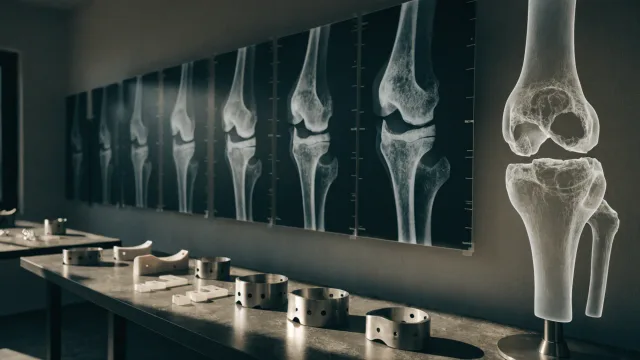
A revision assessment includes the full surgical history, wound and antibiotic history, examination and serial weight-bearing X-rays. Blood tests such as ESR and CRP help screen for infection. Aspiration and synovial or culture tests may follow. CT or nuclear imaging is used selectively.
No X-ray, blood test or scan answers every case. Findings are interpreted together. If the diagnosis remains uncertain, proceeding directly to component exchange can create another painful knee without correcting the cause. [2],[3],[4]
What may be revised?
If one component is problematic and the remaining components are well fixed, correctly positioned and compatible, a limited revision may occasionally be possible. Other patients need removal of the full femoral and tibial components.
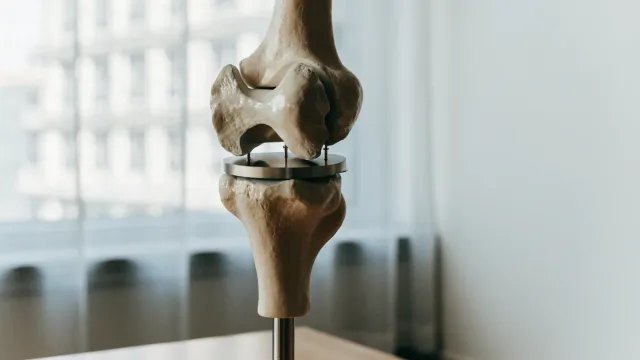
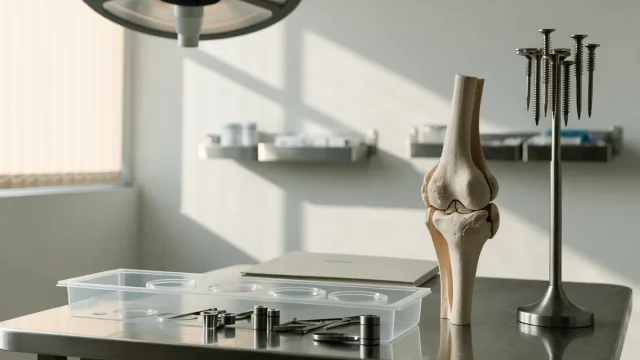
Revision implants often need longer stems for support. Bone defects may require augments or cones. Ligament damage can require greater implant constraint. These are selected after the surgeon understands the bone, fixation and stability problem. [5]
How revision differs from the first replacement
The old components must be identified and, when necessary, removed without sacrificing avoidable bone. Scar tissue changes the exposure. The ligaments and extensor mechanism may already be damaged. The surgeon also needs a plan for defects that are larger than the X-rays suggested.
This can mean a longer operation, more component choices and a less predictable recovery than primary TKR. It also means that an apparently simple liner exchange should not be promised until fixation, alignment, compatibility and infection have been assessed.
Why more constraint is not automatically better
Constraint means that the implant provides more mechanical stability when the knee's own ligaments cannot. It can be necessary in a damaged or unstable knee. It also transfers different forces to the fixation and bone. The surgeon therefore uses enough constraint to solve the stability problem, rather than choosing the most constrained design by default.
Bone loss needs a reconstruction plan
Removing a loose or well-fixed component may leave defects in the thigh bone or shin bone. Small defects and major structural loss are managed differently. Cones, augments, stems and graft are tools, not a standard shopping list. Current imaging suggests what may be required, while direct inspection confirms the final choice.
When infection changes the pathway
Infection may be managed through different strategies depending on timing, organism, implant stability, soft tissues and patient health. Options can include debridement with implant retention, one-stage revision or staged revision. None can be guaranteed from an initial email or X-ray.
A staged pathway may involve removal of the implant, an antibiotic spacer, antimicrobial treatment and later reconstruction. It changes the expected stay, return journey, cost and rehabilitation. [3],[5]
What happens to samples during surgery?
When infection remains part of the differential diagnosis, the surgical team may collect multiple tissue or fluid samples for microbiology and sometimes histology. Results may take time and can affect the final treatment. The patient should know who will communicate a late culture after discharge.
Antibiotic decisions belong to the treating clinical team. Starting an unplanned course before a scheduled assessment can make interpretation harder, while delaying treatment in an acutely ill patient can be dangerous.
Why there is no generic revision price
Primary TKR package prices should not be applied to revision. A custom package is created after the likely reconstruction and required components are understood. It should state the working diagnosis, implant assumptions, expected admission and what would happen if infection tests or operative findings change the plan.
Revision estimates vary because removing a well-fixed component, treating infection, rebuilding bone loss and providing constraint require very different resources. A low headline figure without those assumptions is not a useful comparison.
Prepare the patient as well as the implant
Anaemia, diabetes, nutrition, skin problems, smoking, heart or lung disease and active infection elsewhere can affect the pathway. Optimisation is individual and may need to happen before travel. Bring a complete medicine list and do not alter anticoagulants or antibiotics without instructions from the clinicians managing them.
The home situation matters too. Steps, a low toilet, lack of a companion or limited physiotherapy access can make discharge difficult, particularly if weight bearing is restricted. These details should be discussed before the patient travels.
Consent should cover more than one neat scenario
Revision findings can be different from the best preoperative estimate. Before surgery, discuss which components may be retained, what would require a full revision, how unexpected bone loss would be handled and whether cultures could alter the pathway. The patient should understand possible weight-bearing restrictions and the chance of staged treatment.
Records before travelling
The operation notes, implant labels, comparison images and infection results help define the reconstruction. Use the revision records guide and its printable records inventory. Send what you have; the reviewing team should identify material that is missing and help you work out how to obtain it.
What improvement is realistic?
The aim may be to reduce pain, restore stability or make walking and everyday tasks more manageable. Revision cannot promise a pain-free knee or the movement you had before the first operation. Pain, stiffness or functional limits can remain even when the reconstruction addresses the problem. [5]
Discuss the activities that matter to you: getting out of a chair, managing stairs, walking outdoors or returning to a standing job. The expected gain should be weighed against the complexity, risks and rehabilitation involved.
Recovery and return home
Recovery depends on the reconstruction. Some patients can bear weight early. Others need protection while bone or soft tissue heals. Infection treatment can add weeks or a second operation. The physiotherapy and home plan must match those restrictions.
For a flight over four hours after an uncomplicated revision without infection, the first reassessment is usually at four to six weeks or later. Infection-related or staged treatment has no preset flight window. Wound healing, mobility, anaemia, VTE risk, medication and airline requirements are assessed individually.
Rehabilitation begins with the restrictions created by the reconstruction. A patient with a straightforward stable revision may work on walking and movement early. A patient with fracture repair, tendon reconstruction or major bone loss may need a brace or protected loading. The discharge document must say which plan applies. [5]
Start a preliminary review through the international patient form, email or WhatsApp. Urgent symptoms should be assessed locally first.
Plan the international pathway in stages
The provisional plan and estimate should follow the records review, with enough time allowed for further tests and medical clearance. Flexible travel and a home-clinician handover make a complex pathway easier to manage. The flight guide explains the departure assessment.
A complex case may not fit into one visit. The patient should understand that possibility before making work, family and financial commitments.
Questions for the final written plan
- What is the working cause of failure?
- Which infection tests support the plan?
- Which components may be retained or removed?
- Which stems, cones, augments or constraint may be needed?
- What stay and weight-bearing assumptions are being used?
- What would turn the operation into a staged pathway?
- Who provides hands-on care after I return home?