Some studies show modest early benefits from the subvastus approach in selected patients. The first few days may be easier, with earlier straight-leg raise, slightly less day-one pain and more movement at one week on average. The cited trials did not establish a lasting functional advantage. [1]
I offer subvastus knee replacement at Aster MIMS Kannur when the approach suits the knee. Stiffness, deformity, previous surgery and the exposure needed for a safe reconstruction all enter that decision.
On this page
What changes in a subvastus operation?
A knee replacement needs an opening that lets the surgeon see the damaged surfaces, balance the ligaments and position the components. The commonly used medial parapatellar approach opens beside the kneecap and extends through part of the quadriceps tendon.
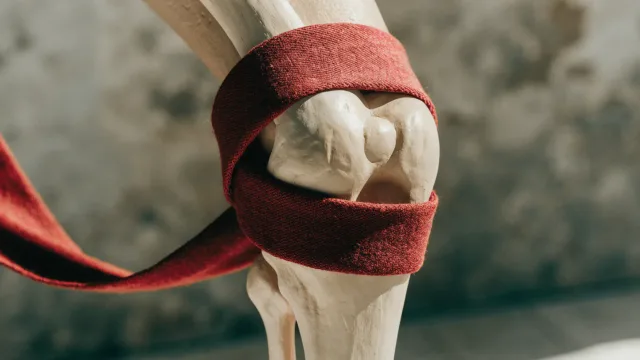
The subvastus route passes under the vastus medialis muscle on the inner side of the thigh. The quadriceps tendon is left intact. This is why it is often described as muscle-sparing, although that phrase should not be taken to mean the knee experiences no tissue trauma.
The damaged bone still has to be prepared, the joint capsule is opened and the tissues around the knee still react to surgery. Swelling, bruising, pain and temporary weakness are expected parts of recovery. “Muscle-sparing” describes the route through the extensor mechanism. It does not describe the whole operation. [1]
Is it the same as a small incision?
No. The skin incision and the deeper exposure are related but not interchangeable. A short skin cut can still use a different approach underneath, while a subvastus operation may need a longer incision to obtain safe visibility.
The incision should be long enough for accurate bone preparation, ligament assessment and implant placement without excessive pressure on the skin. Scar length is a poor way to judge the quality of a knee replacement.
How large are the early differences?
A 2018 review combined 20 randomised trials involving 1,893 primary knee replacements. On average, patients in the subvastus groups regained an active straight-leg raise about 1.7 days earlier. Day-one pain was 0.8 points lower on a ten-point scale, and knee movement at one week was about seven degrees greater. [1]
Those averages help explain the likely size of benefit. A difference can be statistically clear without transforming the whole recovery. Some patients may notice it. Others may not, especially when pain control, strength or medical illness has a larger effect.
| Time | What evidence suggests | What it does not prove |
|---|---|---|
| First days | Earlier straight-leg raise and slightly lower day-one pain on average | A painless operation or independent walking immediately |
| One week | More flexion on average | That every patient will bend farther |
| Six weeks onward | Similar Knee Society Scores in the cited review | Long-term superiority or longer implant life |
Why is it not used for every knee?
The opening can be tighter. A very stiff knee, marked deformity, bulky tissues, previous scars or a complex reconstruction may require a different exposure. Clear access matters because the surgeon must protect the tissues, see the bone accurately and balance the knee.
Sometimes the safest decision is to extend or change the exposure during surgery. The exposure should change when that gives safer visibility. [1]
How suitability is assessed
The surgeon reviews standing X-rays, alignment, movement, body build and previous scars. A knee that bends poorly or has a fixed deformity can be harder to expose through a limited route. Previous operations may have altered the normal tissue planes.
Medical fitness does not usually decide the incision alone, but it strongly affects the whole recovery. Diabetes control, anaemia, skin condition, smoking, nutrition and other health problems still need attention. No approach removes the need for normal preoperative preparation.
Other factors may matter more
Early recovery also depends on anaesthesia, pain relief, control of nausea, swelling, medical health, preoperative strength and the rehabilitation plan. The implant still has to be positioned and balanced well. A small incision cannot compensate for a poor overall pathway.
Enhanced-recovery programmes combine several parts of care. They include education, medical optimisation, safe mobilisation and coordinated discharge. It is usually the combined pathway, not one incision choice, that shapes the hospital experience. [2]
What early recovery may feel like
An earlier straight-leg raise can make bed movement and walking practice easier, but it is only one milestone. The patient must also be able to stand safely, control the operated leg, use a walking aid and manage the bathroom. Pain, dizziness or nausea can slow progress even when quadriceps control is good.
During the first week, swelling often changes through the day. Exercise should follow the individual physiotherapy plan. Pushing the knee aggressively because the approach was advertised as quicker can increase discomfort without improving the overall recovery.
By later follow-up, the focus shifts from the approach name to movement, strength, walking quality, function and the appearance of the X-rays. The cited review did not show a lasting Knee Society Score advantage from the subvastus route. [1]
Does the approach change the implant?
Not automatically. The surgeon still selects the implant from the diagnosis, anatomy, ligament function, bone quality and operative plan. Conventional or robotic assistance may be used according to the clinical plan. CORI is arranged when needed for the operation. The access route does not turn the implant into a special “subvastus knee”.
Risks still need a normal consent discussion
Infection, blood clots, stiffness, fracture, nerve or vessel injury, persistent pain and the possibility of later revision remain part of knee-replacement consent. A limited exposure can also make visibility difficult in an unsuitable knee. The reason for offering subvastus surgery should therefore be clinical, not simply cosmetic.
What should an overseas patient plan?
The usual inpatient pathway for primary replacement is three days. The incision does not shorten the travel-planning window automatically. For a flight longer than four hours, an uncomplicated one-sided TKR is usually first reassessed at 14 to 21 days.
Accommodation, support and a flexible ticket should be planned around the clinical review. Read the flight-safety guide before using any recovery claim to choose a return date.
The discharge handover should include the operative note and rehabilitation plan. A physiotherapist in the patient's country does not need to treat the knee as fragile merely because a subvastus route was used, but should follow any specific restriction documented by the surgeon.
Questions to discuss with the surgeon
- Why does this approach suit my knee?
- What might make another exposure safer?
- How will the plan change if the knee is harder to expose?
- Which parts of the recovery pathway are the same?
- What are realistic milestones for walking and stairs?
- When will travel be reassessed?
The approach is one part of a total knee replacement. The diagnosis, implant plan, alignment, balance and rehabilitation remain central. For general preparation, see the knee replacement page and the first-week recovery guide.